Eureka! · No. 81
The Market Day at Aunae
아우내 장날의 만세
Yu Gwan-sun · 유관순 — Aunae market, Cheonan, Korea, 1 April 1919
💡 The Idea
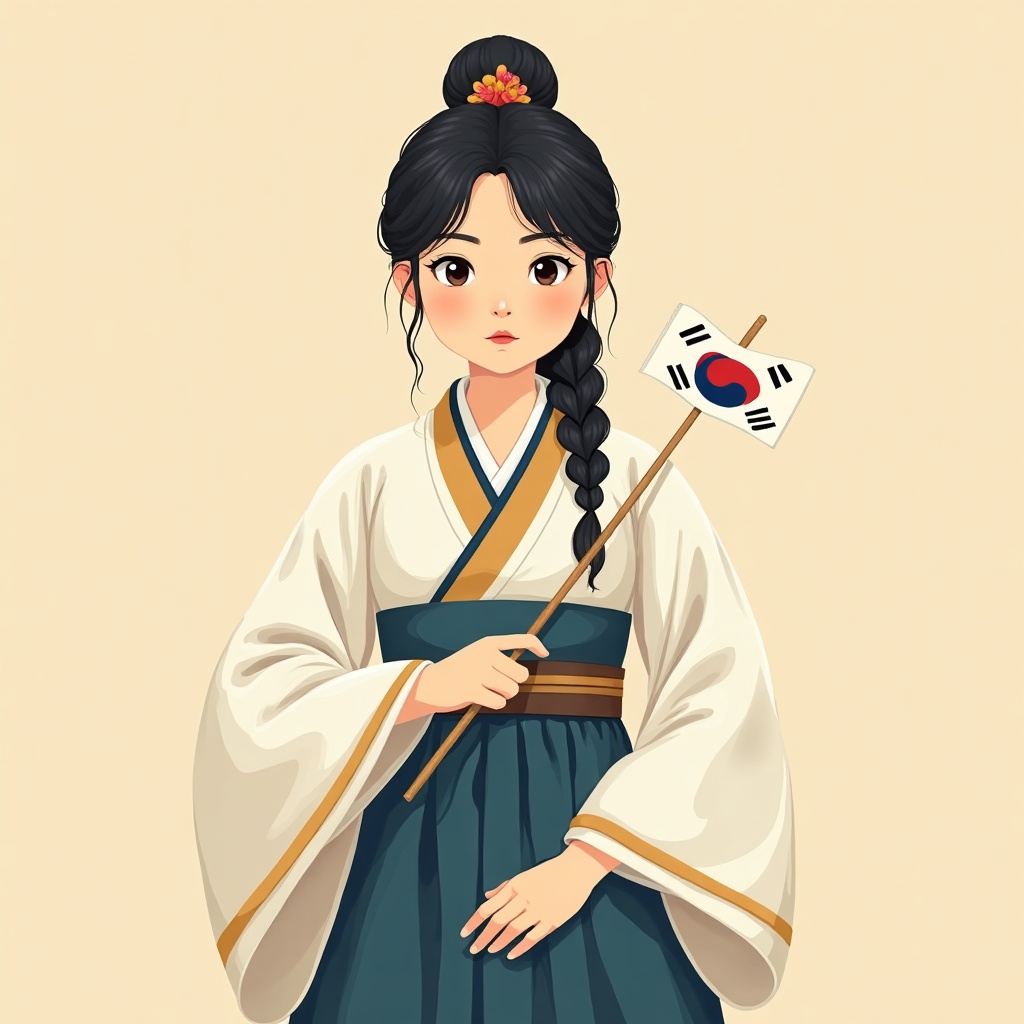
Yu Gwan-sun (柳寬順) was born on 16 December 1902 in Jiryeong-ri, Mokcheon county (now Yongdu-ri, Byeongcheon-myeon, Cheonan), according to the Encyclopedia of Korean Culture (Academy of Korean Studies). An English-language encyclopedia gives the same date. Her father was Yu Jung-gwon and her mother was Lee So-je. Her family had a Protestant background through her grandfather and her uncle. In 1916 a missionary, Alice Sharp, recommended her, and she entered Ewha Haktang in Seoul as a school-paid student. She finished the lower course on 18 March 1918 and began the upper course on 1 April 1918. 1919: the encyclopedia says that Gojong died on 21 January 1919, that the Ewha students wore mourning clothes, and that on 28 February they decided to take part in the protests. On 1 March, Yu Gwan-sun formed a group of five with Seo Myeong-hak, Kim Bok-sun, Kim Hui-ja and Guk Hyeon-suk. They left the dormitory in white clothes, mourned in front of Daehanmun, and joined the march to Namdaemun. On 5 March she took part in another students' protest, was arrested and was released soon after. On 10 March the schools were closed, and on 13 March she took the train home. Another encyclopedia entry (on the Cheonan March 1st Movement) says that she brought a secret copy of the Declaration of Independence. Aunae: at home she told her father, Cho In-won and other village elders about Seoul, and made Korean flags with her cousin Yu Ye-do. The Cheonan entry says that in the afternoon of 1 April 1919 about 3,000 people had gathered at the Aunae market, where Cho In-won read the Declaration. Then the Japanese military police fired on the crowd. The same entry says 19 people died on the spot and 30 were injured. The entry on Yu Gwan-sun says "her parents" were among the 19, and the entry on her brother Yu U-seok says that his father Yu Jung-gwon and his mother "Lady Lee" died on the spot. The three entries have different authors. An English-language encyclopedia also says that her parents died. (1 April 1919 is the Western-calendar date. In the lunar calendar it was the first day of the third month. We use 1 April.) Her role: the encyclopedia says she led the protest together with the village elders. The Cheonan entry says Cho In-won read the Declaration. We say she "helped to organize" it. Prison: the encyclopedia says she was held at Gongju, where she met her brother, and was sentenced to five years in Gongju on 9 May 1919 and to three years in Seoul on 30 June 1919. A scholar's article in the reference list is about the disagreement over the first sentence, and an English-language encyclopedia gives "five years", so we write only "three to five years". She did not appeal. At Seodaemun Prison she took part in the 1 March 1920 ceremony. The encyclopedia says about 3,000 prisoners joined in. A special pardon of 28 April 1920 shortened her sentence to a year and a half. She died on 28 September 1920. The direct cause of death is not recorded. The encyclopedia names long torture and malnutrition, and mentions a scholar's view based on her prison record photo. The Ewha principal, Jeanette Walter, demanded the body and threatened to tell American newspapers. The prison gave it back on condition of a quiet funeral, and it was buried on 14 October 1920 at Itaewon. The grave was later lost; a memorial tomb for her spirit (chohonmyo) was set up near her home. Her age: from 16 December 1902 to 28 September 1920 is 17 years and nine months. The English-language encyclopedia says 17. The Encyclopedia of Korean Culture says 18. We do not know how that source counted. (1920 minus 1902 is 18; the traditional Korean count would give 19.) We write "17, by her birth date" and mention the other number. Honours: she received the Independence Medal in 1962 and the Republic of Korea Medal in 2019 (Encyclopedia of Korean Culture). Ewha gave her an honorary diploma in 1996. About the story: no line of talk in this unit is imagined. We did not use famous quotes or details of what she suffered in prison, because we could not confirm their wording and because of the age of our readers. We could not reach the websites of the Independence Hall of Korea, the National Museum of Korean Contemporary History or the Korea JoongAng Daily, so the facts come from the Encyclopedia of Korean Culture (the entries on Yu Gwan-sun, the Cheonan March 1st Movement and Yu U-seok), plus one English-language encyclopedia for the age and the 1 April date.
유관순(柳寬順)은 한국학중앙연구원의 한국민족문화대백과사전에 따르면 1902년 12월 16일 목천군 지령리(지금의 천안시 병천면 용두리)에서 태어났어요. 영어 백과사전도 같은 날짜를 써요. 아버지는 유중권, 어머니는 이소제예요. 집안은 할아버지와 숙부를 통해 개신교 배경이 있었어요. 1916년에 선교사 샤프(Alice Sharp)의 추천으로 그녀는 교비 유학생으로 서울의 이화학당에 들어갔어요. 1918년 3월 18일에 보통과를 마치고 4월 1일에 고등과에 올라갔어요. 1919년은 이래요. 대백과사전에 따르면 고종은 1919년 1월 21일에 세상을 떠났고 이화학당 학생들은 상복을 입었으며 2월 28일에 시위에 참여하기로 결의했어요. 3월 1일에 유관순은 서명학, 김복순, 김희자, 국현숙과 함께 다섯 명의 결사대를 만들었어요. 그들은 흰 옷을 입고 기숙사를 나와 대한문 앞에서 곡을 한 뒤 남대문으로 가는 행렬에 합류했어요. 3월 5일에는 또 다른 학생 시위에 참여했다가 붙잡혔지만 곧 풀려났어요. 3월 10일에 학교가 문을 닫았고, 3월 13일에 그녀는 기차로 고향에 돌아왔어요. 다른 백과사전 항목(천안 3·1운동)은 그녀가 독립선언서를 몰래 가지고 내려왔다고 해요. 아우내는 이래요. 집에서 그녀는 아버지, 조인원 등 마을 어른들에게 서울 이야기를 하고 사촌 언니 유예도와 태극기를 만들었어요. 천안 항목에 따르면 1919년 4월 1일 오후에 약 3,000명이 아우내 장터에 모였고, 조인원이 독립선언서를 읽었어요. 그 뒤 일본 헌병이 군중에게 총을 쏘았어요. 같은 항목은 그 자리에서 19명이 목숨을 잃고 30명이 다쳤다고 해요. 유관순 항목은 19명 중에 "부모"가 있었다고 하고, 오빠 유우석 항목은 아버지 유중권과 어머니 이씨가 그 자리에서 순국했다고 해요. 세 항목은 집필자가 서로 달라요. 영어 백과사전도 부모가 목숨을 잃었다고 해요. (1919년 4월 1일은 양력 날짜이고, 음력으로는 3월 1일이었어요. 우리는 양력 4월 1일을 써요.) 그녀의 역할은 이래요. 대백과사전은 그녀가 마을 어른들과 함께 시위를 이끌었다고 하고, 천안 항목은 조인원이 독립선언서를 읽었다고 해요. 그래서 우리는 그녀가 시위를 "준비하는 일을 도왔다"고 적었어요. 감옥은 이래요. 대백과사전에 따르면 그녀는 공주에 갇혀 오빠를 만났고, 1919년 5월 9일 공주에서 징역 5년을, 6월 30일 서울에서 징역 3년을 선고받았어요. 참고문헌의 한 학술 논문은 1심 형량에 대한 견해 차이를 다루고, 영어 백과사전은 "5년"이라고 써서, 우리는 "3년에서 5년"이라고만 적었어요. 그녀는 상고하지 않았어요. 서대문형무소에서 그녀는 1920년 3월 1일 기념식에 참여했어요. 대백과사전은 수감자 약 3천 명이 호응했다고 해요. 1920년 4월 28일의 특사령으로 형기는 1년 6개월로 줄었어요. 그녀는 1920년 9월 28일에 세상을 떠났어요. 직접적인 사망 원인은 밝혀지지 않았어요. 대백과사전은 오랫동안 이어진 고문과 영양실조를 들고, 수형기록표 사진을 근거로 한 학자의 견해도 소개해요. 이화학당 교장 월터는 시신을 돌려 달라고 요구하며 미국 신문에 알리겠다고 항의했어요. 형무소는 조용히 장례를 치른다는 조건으로 시신을 돌려주었고, 1920년 10월 14일 이태원에 묻혔어요. 무덤은 나중에 어디인지 알 수 없게 되었고, 고향 가까이에 넋을 기리는 초혼묘가 세워졌어요. 나이는 이래요. 1902년 12월 16일부터 1920년 9월 28일까지는 17년 9개월이에요. 영어 백과사전은 17세라고 하고, 한국민족문화대백과사전은 18세라고 해요. 그 자료가 어떻게 셌는지는 알 수 없어요. (1920에서 1902를 빼면 18이고, 전통적인 우리나라 나이로는 19세가 돼요.) 우리는 "생일 기준 17세"라고 적고 다른 숫자도 함께 언급했어요. 훈장은 이래요. 그녀는 1962년에 건국훈장 독립장을, 2019년에 대한민국장을 받았어요(한국민족문화대백과사전). 이화학당은 1996년에 명예 졸업장을 주었어요. 이야기에 대해: 이 단원에는 상상한 대사가 하나도 없어요. 유명한 말들이나 그녀가 감옥에서 겪은 일의 자세한 내용은 쓰지 않았어요. 말의 정확한 표현을 확인할 수 없었고, 독자의 나이도 생각했기 때문이에요. 독립기념관, 국립현대사박물관, 코리아중앙데일리의 웹사이트에는 접근하지 못해서, 사실은 한국민족문화대백과사전(유관순, 천안 3·1운동, 유우석 항목)과, 나이와 4월 1일 날짜에 대해서는 영어 백과사전 하나에서 가져왔어요.
📚 Grammar focus
Past perfect (had + past participle: an earlier past action)
✏️ Try it
Choose the past perfect or the past simple. 1. When Yu Gwan-sun (arrive) _______ home, the movement (already / spread) _______ through Seoul. 2. Before the market day, she (make) _______ flags with her cousin. 3. The police (arrive) _______ after the crowd (read) _______ the Declaration. 4. She (not / hear) _______ the news before she came home. (negative) 5. By the time the schools closed, she (already / join) _______ two protests. Bonus: Write two sentences about this morning. Use "had" for the earlier action, and "when" or "by the time" for the later action.
전체 레슨을 보고 싶으세요?
Want the full lesson?
회화 연습, 역할극, 문법, 그리고 진짜 선생님이 안에 있어요.
Conversation practice, roleplay, grammar, and a real tutor are inside.