Eureka! · No. 72
The Problem Was Control, Not Power
문제는 힘이 아니라 조종이었어요
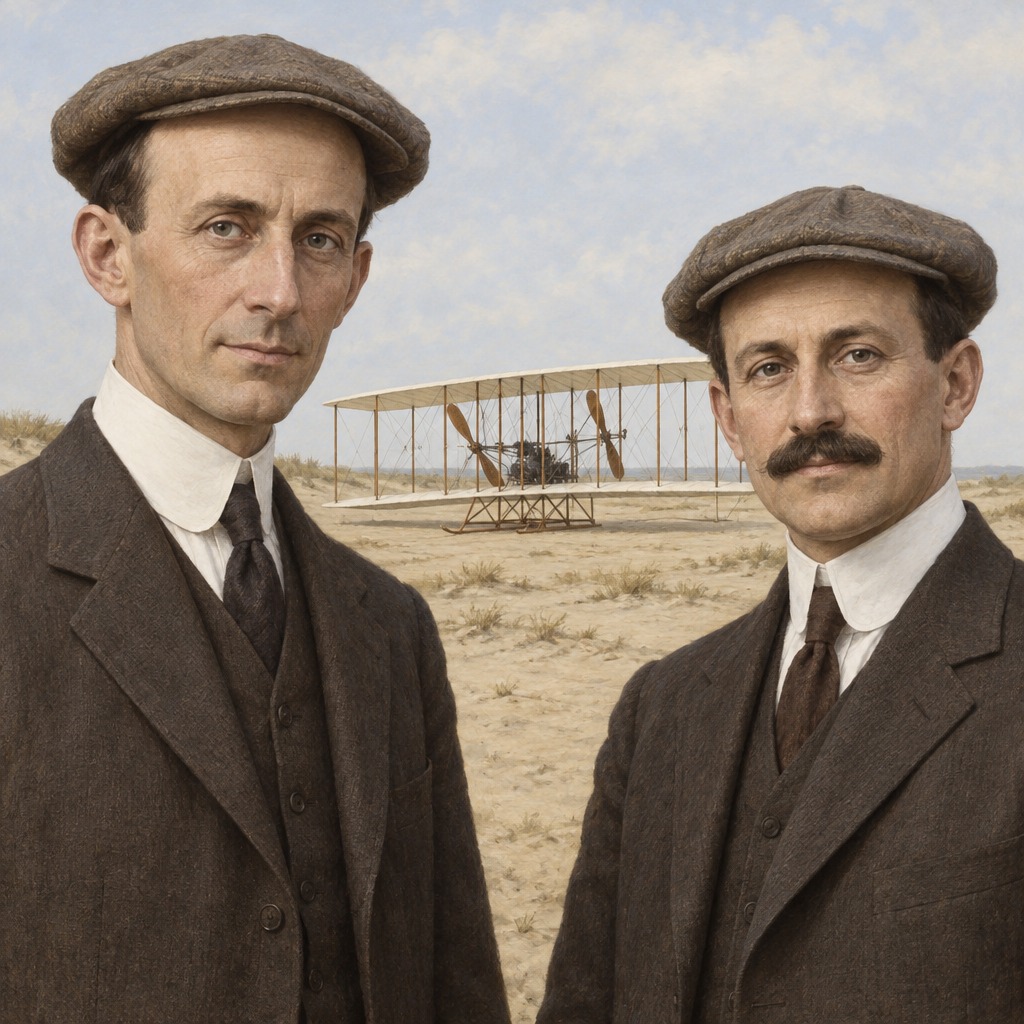
Wilbur and Orville Wright · 윌버 라이트와 오빌 라이트 — Dayton, Ohio and Kitty Hawk, North Carolina, 1899-1903 CE
💡 The Idea
Wilbur Wright (1867-1912) and Orville Wright (1871-1948) are often called "clever bicycle mechanics who somehow invented the airplane". The National Air and Space Museum (NASM) says that this picture is too simple. They owned a bicycle shop in Dayton, Ohio, but their success came from a method: study, test, measure, change the design, and test again. The problem: an airplane needs wings to lift it, an engine to push it, and a way to balance and steer it. The NASM says that most earlier experimenters worked on only one of these problems. The Wrights believed that the wing and engine problems would be easier, so they first worked on control. Wilbur also wrote that flight needed a way to balance and steer; he said that when this one feature was worked out, the other difficulties were of minor importance. Many people wanted an airplane that kept itself stable. The Wrights thought about the bicycle, which is unstable but can be controlled. The NASM says they reasoned that an airplane could also be unstable yet controllable. Their control idea was wing warping: the pilot twists the wing structure, so one wing meets the air at a bigger angle and gives more lift, and the machine banks. They tested it first on a small kite in 1899. The method: after the 1900 and 1901 gliders gave less lift than expected (in 1901, only one third of the lift they predicted), the brothers doubted the published data. They tested a wing on a bicycle-based device, then built a wind tunnel. The NASM says the larger tunnel was built in October 1901 and that its special tools, called balances, measured lift and drag. The museum says they did preliminary tests on as many as 200 model wing shapes and made formal tests on nearly 50 of them, so "about 200" means early trials, not 200 full experiments. Their 1902 glider added a movable rudder, and the NASM calls the resulting three-axis control (pitch, roll and yaw) their most important design breakthrough. For the powered machine, the NASM says ten engine firms replied but none could meet the weight and power needs at a reasonable price, so the Wrights built their own engine with the help of their shop mechanic Charlie Taylor, who did virtually all the machine work. Their propellers were designed as rotary wings. The flights: on December 14, 1903 the Flyer stalled after about 3.5 seconds (Orville's account). Wilbur wrote home, "There is now no question of success" (NASM). On December 17, 1903, near Kitty Hawk, North Carolina, there were four flights, between about 10:30 and 12 o'clock. The first, with Orville, started at 10:35 a.m. and lasted 12 seconds and 120 feet. The second and third were about two hundred feet. The fourth, with Wilbur, covered 852 feet in 59 seconds. Soon after, a gust turned the Flyer over, and it was badly damaged and never flown again. Later, the NASM says, there was a long dispute between Orville and the Smithsonian about how the Smithsonian displayed the work of its former Secretary, Samuel Langley, and credited the Wrights; this unit does not tell that story in full. About the sources: facts about the brothers, the control idea, the wind tunnel, the engine and the flights come from NASM pages ("Who Were the Wright Brothers, Really?", "Researching the Wright Way", "The Wright Brothers Made History at Kitty Hawk", and the 1903 Wright Flyer object page). Details of the flights come from Orville Wright's own account, "How We Made the First Flight", and Wilbur's remarks on balancing and steering come from his "Some Aeronautical Experiments"; both are in the Project Gutenberg book The Early History of the Airplane. The conversation between "Wilbur" and "Orville" is imagined; it only repeats facts from these sources.
윌버 라이트(1867~1912)와 오빌 라이트(1871~1948)는 흔히 "어떻게든 비행기를 발명한 똑똑한 자전거 수리공"이라고 불려요. 미국 국립항공우주박물관(NASM)은 이런 그림이 너무 단순하다고 말해요. 두 사람은 오하이오주 데이턴에서 자전거 가게를 했지만, 성공은 하나의 방법에서 왔어요. 공부하고, 시험하고, 재고, 설계를 바꾸고, 다시 시험하는 방법이에요. 문제는 이래요. 비행기에는 띄워 줄 날개, 밀어 줄 엔진, 그리고 균형을 잡고 방향을 정하는 방법이 필요해요. NASM은 앞선 실험가들 대부분이 이 가운데 한 가지 문제만 붙들었다고 말해요. 라이트 형제는 날개와 엔진 문제가 더 쉬우리라 믿고 먼저 조종 문제를 풀었어요. 윌버도 비행에는 균형을 잡고 방향을 정하는 방법이 필요하다고 썼고, 이 한 가지가 해결되면 다른 어려움은 대수롭지 않다고 말했어요. 많은 사람들은 스스로 안정되는 비행기를 원했어요. 라이트 형제는 불안정하지만 조종할 수 있는 자전거를 떠올렸어요. NASM에 따르면 그들은 비행기도 불안정하지만 조종할 수 있다고 추론했어요. 그들의 조종 아이디어는 날개 휘기였어요. 조종사가 날개 구조를 비틀면 한쪽 날개가 더 큰 각도로 공기를 만나 양력이 커지고, 기계가 기울어요. 그들은 1899년에 작은 연으로 먼저 시험했어요. 방법은 이래요. 1900년과 1901년의 글라이더가 기대보다 양력이 적게 나오자(1901년에는 예상한 양력의 3분의 1뿐이었어요) 형제는 발표된 자료를 의심했어요. 자전거를 바탕으로 한 장치로 날개를 시험한 뒤 풍동을 만들었어요. NASM에 따르면 더 큰 풍동은 1901년 10월에 만들어졌고, 이들이 만든 특별한 도구인 '저울(balances)'이 양력과 항력을 쟀어요. 박물관은 이들이 최대 200개의 모형 날개 모양으로 예비 시험을 했고 그중 50개 가까이는 정식 시험을 했다고 말해요. 그러니 '약 200개'는 초기 시험을 뜻하고 200번의 완전한 실험이 아니에요. 1902년 글라이더에는 움직이는 방향타가 더해졌고, NASM은 그 결과인 3축 조종(피치, 롤, 요)을 가장 중요한 설계 돌파구라고 불러요. 동력 기계에는 엔진 회사 열 곳이 답했지만 무게와 힘의 조건을 알맞은 값에 맞출 수 없었다고 NASM은 말해요. 그래서 라이트 형제는 가게 기계공 찰리 테일러의 도움으로 엔진을 직접 만들었고, 테일러가 거의 모든 기계 가공을 했어요. 프로펠러는 돌아가는 날개처럼 설계했어요. 비행은 이래요. 1903년 12월 14일에 플라이어는 약 3.5초 만에 실속했어요(오빌의 기록). 윌버는 집에 "성공에 대한 의심은 이제 없다"고 썼어요(NASM). 1903년 12월 17일 노스캐롤라이나주 키티호크 근처에서 약 10시 30분부터 12시 사이에 비행이 네 번 있었어요. 오빌이 탄 첫 비행은 오전 10시 35분에 시작해 12초 동안 120피트를 갔어요. 두 번째와 세 번째는 약 200피트였어요. 윌버가 탄 네 번째는 59초 동안 852피트를 갔어요. 곧 돌풍이 플라이어를 뒤집었고, 심하게 부서져 다시는 날지 못했어요. 나중에 오빌과 스미스소니언 사이에 긴 다툼이 있었다고 NASM은 말해요. 스미스소니언이 전 사무총장 새뮤얼 랭글리의 업적을 전시한 방식과 라이트 형제의 업적을 인정한 방식에 관한 것이었어요. 이 단원은 그 이야기를 자세히 다루지 않아요. 출처에 대해: 형제에 관한 사실, 조종 아이디어, 풍동, 엔진, 비행은 NASM 자료('Who Were the Wright Brothers, Really?', 'Researching the Wright Way', 'The Wright Brothers Made History at Kitty Hawk', 1903 라이트 플라이어 소장품 페이지)에서 가져왔어요. 비행의 세부 내용은 오빌 라이트가 직접 쓴 글 'How We Made the First Flight'에서, 균형 잡기와 방향 정하기에 관한 윌버의 말은 그가 쓴 'Some Aeronautical Experiments'에서 가져왔어요. 두 글 모두 프로젝트 구텐베르크의 책 The Early History of the Airplane에 실려 있어요. '윌버'와 '오빌'의 대화는 상상한 것이고, 이 자료들의 사실만 되풀이해요.
📚 Grammar focus
Sequence words (first / next / then / after that / finally)
✏️ Try it
Fill in each blank with First, Next, Then, After that or Finally. Use each word once. _______ (1), Wilbur wrote to the Smithsonian to ask for books about flight. _______ (2), the brothers built a small kite to test wing warping. _______ (3), they flew gliders at Kitty Hawk. _______ (4), they built a wind tunnel in Dayton and tested many wing shapes. _______ (5), in December 1903, their powered Flyer flew. Choose the correct word: 6. (At first / First), the 1900 glider worked well. Later, the 1901 glider gave too little lift. 7. They tested a wing on a bicycle. (After that / After), they built a wind tunnel. Bonus: Write four sentences about how to make something you know well (for example tea or a sandwich). Use First, Next, Then and Finally.
전체 레슨을 보고 싶으세요?
Want the full lesson?
회화 연습, 역할극, 문법, 그리고 진짜 선생님이 안에 있어요.
Conversation practice, roleplay, grammar, and a real tutor are inside.