Eureka! · No. 53
Wash Your Hands, Save a Life
손을 씻으면 생명을 구해요
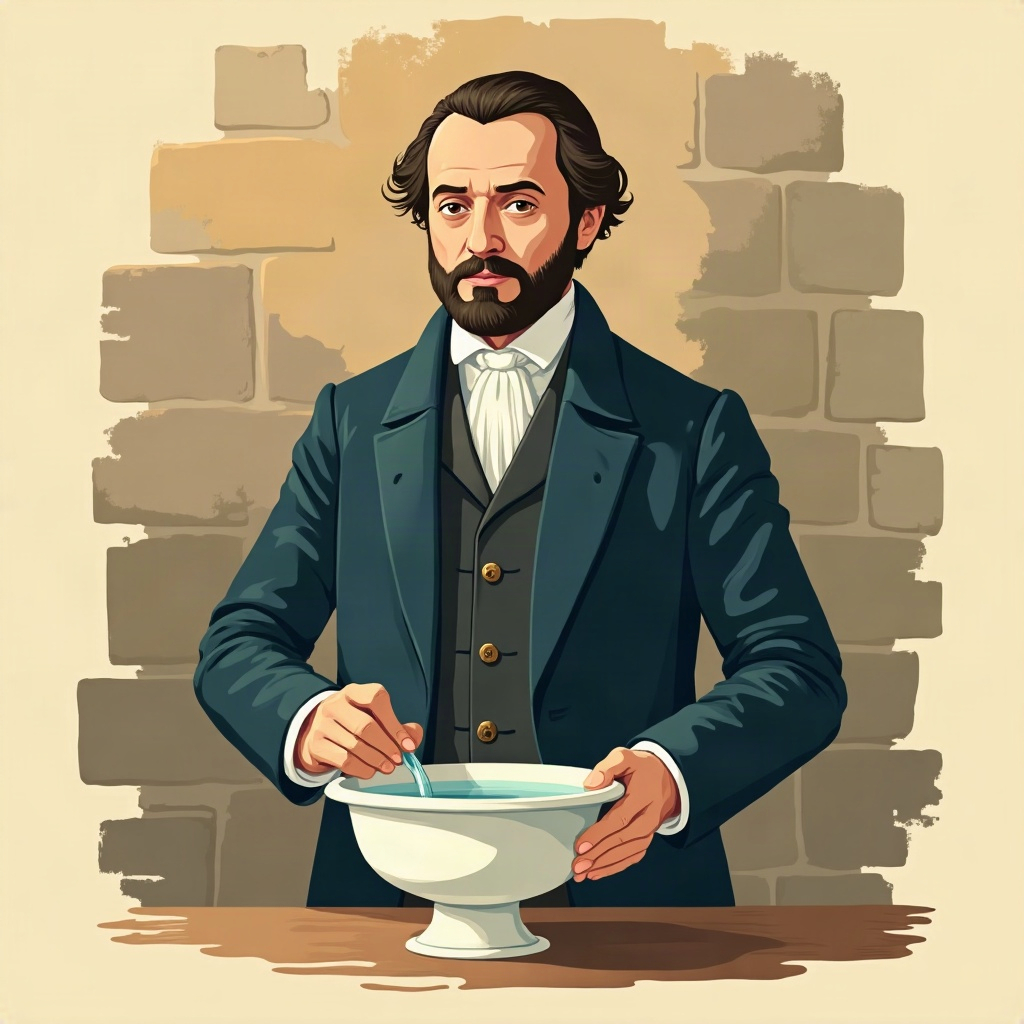
Ignaz Semmelweis · 이그나츠 제멜바이스 — Vienna, 1847
💡 The Idea
Ignaz Semmelweis was born on 1 July 1818 in Buda, now part of Budapest in Hungary. He finished his medical studies in 1844 and began to work in obstetrics (the care of mothers and babies at birth) in Vienna. From July 1846 he worked as an assistant in the first obstetric clinic of the Vienna General Hospital. The hospital had two clinics. In the first, doctors and medical students worked and learned. In the second, midwives learned. Childbed fever (puerperal fever) was a leading cause of death for new mothers, and Semmelweis noticed that the death rate was much higher in the first clinic. In 1846, 459 of 4,010 mothers died in the first clinic (11.4 percent), and 105 of 3,754 died in the second (2.7 percent). He checked ideas such as bad air, weather and crowding. None of them could explain the difference, because they were the same for both clinics. The clue came in March 1847, when Professor Jakob Kolletschka died after a cut in his finger during an autopsy. Semmelweis saw that the findings in Kolletschka's body were the same as in the mothers. He guessed that doctors and students were carrying "cadaveric particles" from autopsies to the mothers on their hands. Nobody knew about germs yet, and Semmelweis did not know the cause. He used a strong cleaning liquid, a chlorinated lime solution, because soap and water alone had not worked. What did the numbers show? Hand-washing with the solution began in about mid-May 1847. In 1848, 45 of 3,556 mothers died in the first clinic (1.3 percent), the same as in the second clinic (43 of 3,219, also 1.3 percent). A modern re-analysis of the monthly records found a rate of about 11.3 percent in the first clinic from 1840 to October 1846 and about 2.0 percent from June 1847 to February 1849. The same study shows that the numbers were not a straight line: for some months in early 1847, when a different assistant was in charge and students did fewer autopsies, the rate was lower, and it rose again to 18.3 percent in April 1847. Colleagues largely rejected his idea in his lifetime. Dr Nicholas Kadar writes that most leading obstetricians rejected it because it conflicted with all the theories of the time, and he calls the story that Semmelweis failed because of a difficult character a myth. Other scholars point out that Semmelweis was slow to publish: his friend Ferdinand von Hebra reported the findings in late 1847, and Semmelweis's own book appeared in 1861. Two of them, Lynøe and Juth, also note that the early results were mixed: three of the seven months from June to December 1847 showed higher mortality than expected, which they link, for example, to one patient with an infected cancer of the womb. He died in 1865, at the age of 47. About fifteen years later germ theory was accepted, and his work was honoured. Today, hand hygiene is a basic rule in hospitals. About the sources: all numbers come from open-access medical-history articles (Kadar 2019 in the American Journal of Obstetrics and Gynecology, Stang and Standl 2022, Lynøe and Juth 2025, and others). Some articles disagree on small details (for example, some give 18.27 percent as the rate for the whole of 1847, but a careful re-analysis shows 18.3 percent was the rate only for April 1847). This unit uses the figures that agree in several sources. The conversation is imagined.
이그나츠 제멜바이스는 1818년 7월 1일 헝가리 부다에서 태어났어요. 부다는 지금 부다페스트의 일부예요. 그는 1844년에 의학 공부를 마쳤고 빈에서 산부인과(출산 때 어머니와 아기를 돌보는 분야) 일을 시작했어요. 1846년 7월부터 빈 종합병원 제1산부인과 병동에서 조수로 일했어요. 병원에는 병동이 둘 있었어요. 첫째 병동에서는 의사와 의대생이 일하고 배웠어요. 둘째 병동에서는 조산사가 배웠어요. 산욕열(childbed fever)은 새로 엄마가 된 여성들의 주요 사망 원인이었고, 제멜바이스는 첫째 병동의 사망률이 훨씬 높다는 것을 알아챘어요. 1846년 첫째 병동에서는 4,010명 가운데 459명(11.4퍼센트)이, 둘째 병동에서는 3,754명 가운데 105명(2.7퍼센트)이 사망했어요. 그는 나쁜 공기, 날씨, 붐비는 정도 같은 생각들을 살폈어요. 두 병동에 똑같이 해당했기 때문에 어느 것도 차이를 설명하지 못했어요. 단서는 1847년 3월에 왔어요. 야코프 콜레치카 교수가 부검 중 손가락을 베인 뒤 세상을 떠났어요. 제멜바이스는 콜레치카의 몸에서 나온 소견이 산모들의 것과 같다는 것을 알았어요. 그는 의사와 학생들이 부검에서 묻은 "시신의 입자"를 손에 묻혀 산모들에게 옮긴다고 추측했어요. 아직 아무도 세균에 대해 몰랐고, 제멜바이스도 원인을 알지 못했어요. 그는 비누와 물만으로는 소용이 없었기 때문에 강한 세정액인 염화석회 용액을 썼어요. 숫자는 무엇을 보여 주었을까요? 이 용액으로 손을 씻기 시작한 때는 1847년 5월 중순쯤이에요. 1848년에는 첫째 병동에서 3,556명 가운데 45명(1.3퍼센트)이 사망해 둘째 병동(3,219명 가운데 43명, 역시 1.3퍼센트)과 같아졌어요. 월별 기록을 현대에 다시 분석해 보니 첫째 병동의 비율은 1840년부터 1846년 10월까지 약 11.3퍼센트, 1847년 6월부터 1849년 2월까지 약 2.0퍼센트였어요. 같은 연구는 숫자가 일직선으로 움직이지 않았다는 것도 보여 줘요. 1847년 초 몇 달 동안은 다른 조수가 일을 맡고 학생들이 부검을 덜 해서 비율이 더 낮았고, 1847년 4월에 18.3퍼센트로 다시 올랐어요. 동료들은 그의 생애 동안 그의 생각을 대부분 거부했어요. 니컬러스 카다르 박사는 주요 산부인과 의사 대부분이 그 생각이 당시의 모든 이론과 충돌해서 거부했다고 쓰고, 제멜바이스가 까다로운 성격 때문에 실패했다는 이야기는 신화라고 해요. 다른 학자들은 제멜바이스가 글을 늦게 냈다고 지적해요. 친구 페르디난트 폰 헤브라가 1847년 말에 연구 결과를 알렸고, 제멜바이스 본인의 책은 1861년에 나왔어요. 그중 뤼뇌(Lynøe)와 유트(Juth)는 초기 결과가 엇갈렸다고도 말해요. 1847년 6월부터 12월까지 일곱 달 중 세 달은 사망률이 기대보다 높았고, 이를 예를 들어 감염된 자궁암을 앓던 환자 한 명과 연결해요. 그는 1865년 47세에 세상을 떠났어요. 약 십오 년 뒤 세균 이론이 받아들여졌고, 그의 업적은 높이 평가받았어요. 오늘날 손 위생은 병원의 기본 규칙이에요. 출처에 대해: 모든 숫자는 무료로 공개된 의학사 논문에서 가져왔어요(2019년 《미국 산부인과학회지》의 카다르, 2022년 스탕과 스탄들, 2025년 뤼뇌와 유트 등). 일부 논문은 작은 부분에서 서로 달라요. 예를 들어 1847년 전체 비율이 18.27퍼센트라고 한 글도 있지만, 신중한 재분석은 18.3퍼센트가 1847년 4월 한 달의 비율이었다고 보여 줘요. 이 단원은 여러 자료에서 일치하는 수치를 써요. 대화는 상상한 것이에요.
📚 Grammar focus
Third conditional (imagined past: if + had + past participle, would have + past participle)
✏️ Try it
Complete each sentence with the third conditional (had + past participle, would have + past participle). 1. If the students _______ (wash) their hands, fewer mothers _______ (die). 2. If Semmelweis _______ not _______ (see) the autopsy report, he _______ not _______ (find) the clue. 3. If we _______ (start) earlier, we _______ (save) more mothers. 4. What _______ (happen) if doctors _______ (listen) to him earlier? 5. If I _______ not _______ (eat) breakfast this morning, I _______ (be) hungry. Bonus: Write two sentences about your life. Use "If I had ..., I would have ..." and "If I had not ..., I would not have ...".
전체 레슨을 보고 싶으세요?
Want the full lesson?
회화 연습, 역할극, 문법, 그리고 진짜 선생님이 안에 있어요.
Conversation practice, roleplay, grammar, and a real tutor are inside.