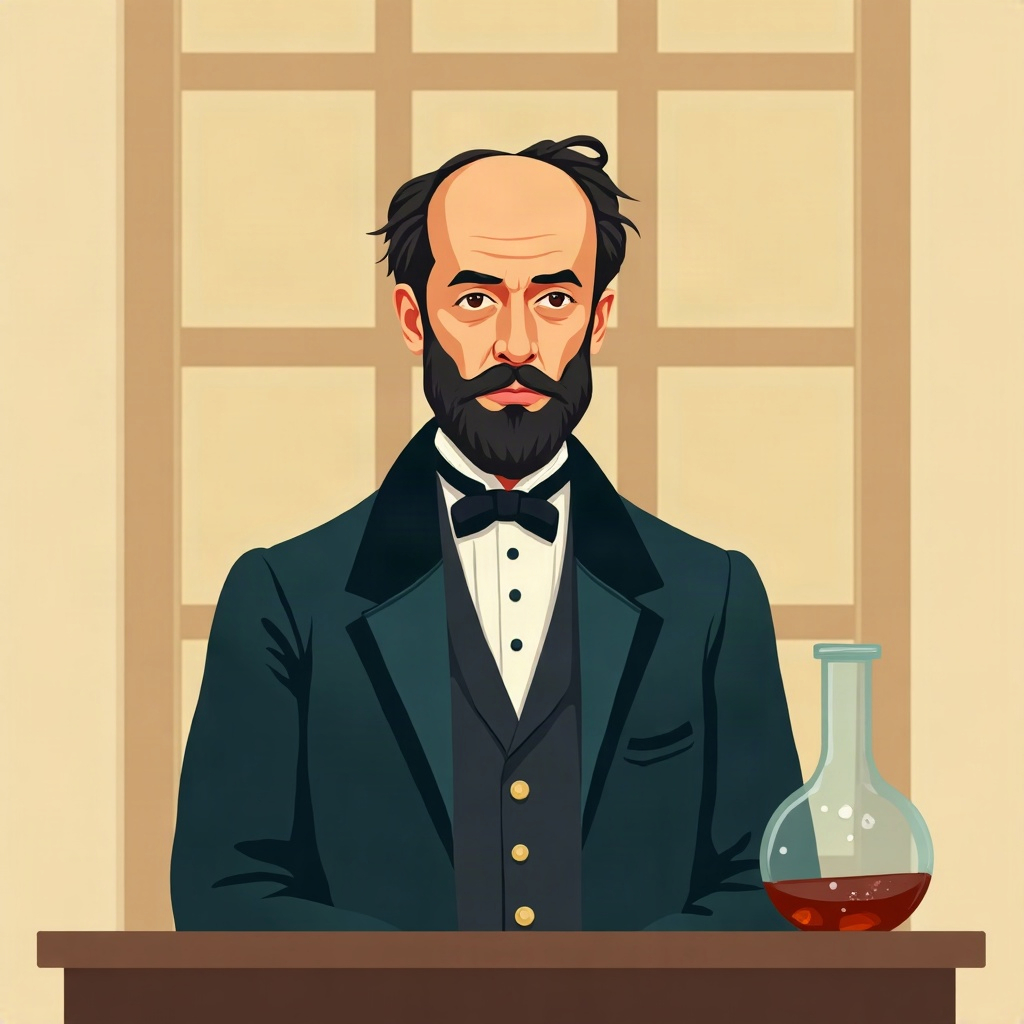
Eureka! · No. 51
The Flask That Kept Out the Germs
세균을 막아 준 플라스크
Louis Pasteur · 루이 파스퇴르 — Paris, c. 1860
💡 The Idea
Louis Pasteur (1822-1895) was born in Dole, in the Jura region of France, and trained as a chemist. His work on fermentation in the 1850s pulled him into a big argument: can living things appear by themselves in broth or old food? This old idea is called spontaneous generation. In 1860 the French Academy of Sciences offered a prize for experiments on the question, and in 1861 Pasteur reported his results on the tiny bodies that float in the air. The full paper was printed in 1862 in the journal Annales de chimie et de physique. His best-known test used a flask with a long neck that was heated and bent into a curve, with the end left open. He boiled a nutrient broth inside it. Air could pass in and out, but the broth stayed unchanged for months. When the flask was shaken so that air rushed in with its dust, living microbes appeared within days. The result suggested that the life in the broth came from germs carried by air and dust, not from the broth itself. About the sources: the year of the paper (1861) and the prize competition (1860) come from the 2012 review "Louis Pasteur, the Father of Immunology?" and the 2022 review "Louis Pasteur: Between Myth and Reality". The steps of the experiment come from Pasteur's own 1862 paper, which is also collected in Œuvres de Pasteur, volume 2. He wrote that the air enters slowly, so its dust falls in the curved neck. He also wrote that violent shaking, or breaking off the neck, lets the dust reach the liquid. He showed open flasks with curved necks to the Academy on 6 February 1860. In the 1862 paper he wrote that some of these flasks had kept liquids that spoil easily unchanged for eighteen months. But the exact day he first made one is not clear, so we say c. 1860. A 2022 review adds two honest notes. It says his colleague Antoine Balard thought of the swan-neck flask design, and it reminds us that scientists such as Theodor Schwann had already done related experiments in 1836. So Pasteur was not the first to test the question, but his careful experiments made the case very strong. The conversation with the student is invented, and the student is not a real person. Later in life Pasteur worked on vaccines, including one for rabies in 1885, and the Institut Pasteur opened in Paris in 1888. Those are other stories for another day.
루이 파스퇴르(1822~1895)는 프랑스 쥐라 지방의 돌에서 태어났고 화학자로 훈련받았어요. 1850년대에 발효를 연구하다가 큰 논쟁에 휘말렸어요. 생물이 국물이나 오래된 음식 속에서 저절로 생길 수 있을까요? 이 오래된 생각을 자연 발생설이라고 불러요. 1860년에 프랑스 과학 아카데미가 이 문제에 대한 실험에 상을 걸었고, 1861년에 파스퇴르는 공기 중에 떠다니는 아주 작은 입자들에 대한 결과를 발표했어요. 전체 논문은 1862년 학술지 《화학·물리학 연보》에 실렸어요. 가장 유명한 실험은 긴 목을 불에 달궈 구부린 플라스크를 썼어요. 끝은 열어 두었어요. 그 안에서 영양 국물을 끓였지요. 공기는 드나들 수 있었지만 국물은 몇 달 동안 변하지 않았어요. 플라스크를 흔들어서 공기가 먼지와 함께 빠르게 들어가자, 며칠 안에 살아 있는 미생물이 나타났어요. 이 결과는 국물 속 생명이 국물 자체가 아니라 공기와 먼지에 실려 온 세균에서 왔다는 것을 보여 줬어요. 출처에 대해: 논문 연도(1861)와 상 공모(1860)는 2012년 논문 〈루이 파스퇴르, 면역학의 아버지?〉와 2022년 논문 〈루이 파스퇴르: 신화와 현실 사이〉에 나와요. 실험의 단계는 파스퇴르 자신의 1862년 논문에서 가져왔어요. 이 논문은 《파스퇴르 전집》 2권에도 실려 있어요. 그는 공기가 천천히 들어오기 때문에 먼지가 굽은 목에 떨어진다고 썼어요. 또 플라스크를 세게 흔들거나 목을 부러뜨리면 먼지가 액체에 닿는다고도 썼어요. 그는 1860년 2월 6일 과학 아카데미에 목이 굽은 열린 플라스크를 보여 주었어요. 1862년 논문에서 그는 이 플라스크 가운데 몇 개가 쉽게 상하는 액체를 18개월 동안 변하지 않게 지켰다고 썼어요. 하지만 처음 만든 정확한 날짜는 분명하지 않아서 1860년경이라고 했어요. 2022년 논문은 두 가지 정직한 사실을 덧붙여요. 동료인 앙투안 발라르가 백조 목 플라스크 모양을 생각해 냈다고 하고, 테오도어 슈반 같은 과학자가 1836년에 이미 비슷한 실험을 했다고도 알려 줘요. 그러니 파스퇴르가 이 문제를 처음 시험한 사람은 아니에요. 하지만 그의 꼼꼼한 실험이 이 주장을 아주 강하게 만들었어요. 학생과의 대화는 지어낸 것이고, 학생은 실제 인물이 아니에요. 파스퇴르는 훗날 1885년의 광견병 백신을 비롯해 백신도 연구했고, 1888년에 파리에 파스퇴르 연구소가 문을 열었어요. 그건 다음에 할 다른 이야기예요.
📚 Grammar focus
First conditional (if + present simple, will + verb)
✏️ Try it
Complete each sentence. Use the correct form of the verb in brackets. 1. If you boil the broth, the germs _______ (die). 2. If the flask _______ (stay) closed, no air will come in. 3. If you shake the flask, dust _______ (enter) it. 4. The broth _______ (not change) if germs cannot reach it. 5. What _______ (happen) if I leave the bowl open? Bonus: Write two "if" sentences about your own life. Use "will" in the result part of each sentence.
전체 레슨을 보고 싶으세요?
Want the full lesson?
회화 연습, 역할극, 문법, 그리고 진짜 선생님이 안에 있어요.
Conversation practice, roleplay, grammar, and a real tutor are inside.