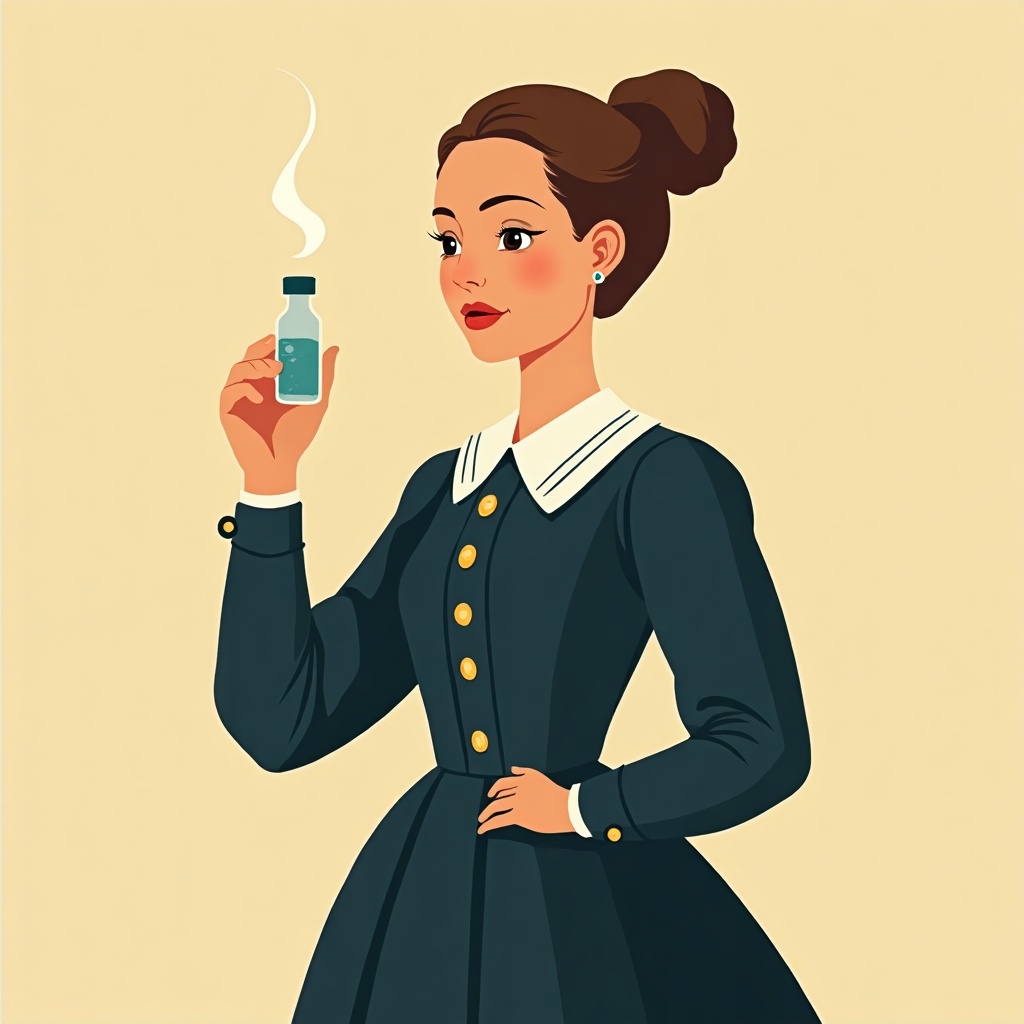
Eureka! · No. 48
The Glow Hidden in a Stone
돌 속에 숨은 빛
Marie Curie · 마리 퀴리 — Paris, 1898
💡 The Idea
Marie Curie (1867-1934) was born Maria Sklodowska in Warsaw. She studied physics and mathematics at the Sorbonne in Paris, married Pierre Curie in 1895, and became the first woman professor of general physics at the Sorbonne in 1906. In 1896 Henri Becquerel found that uranium gives off invisible rays. Marie measured these rays with great care. She found that thorium also gives them off, and she invented the word "radioactivity". Her big surprise came from a mineral called pitchblende. It was more active than the uranium in it could explain. Natural chalcolite was also too active, but a lab-made copy matched its uranium exactly, so the natural minerals had to hide something else. Marie and Pierre used a new method: split the mineral into parts, measure the radiation of every part, and follow the strongest part. In 1898 this method led them to two new elements, polonium and radium. After years of work in the old shed, by 1902 Marie had about one tenth of a gram of pure radium chloride. She never managed to isolate pure polonium. About the dangers: the Curies did not know that strong radiation harms the body. Their fingertips were permanently damaged, and radium is never safe to handle. Please do not look for radioactive material at home. About the sources: the dates, the shed, the Austrian pitchblende, the 1902 result, the glow and the Nobel Prizes come from Marie Curie's Nobel lecture, the Nobel Prize biography and the American Institute of Physics (AIP) exhibit on Marie Curie. The words of Marie and Pierre in the conversation are invented to teach the idea. Some tellings say the shed was freezing in winter and hot in summer. Our sources only say it was poorly ventilated and not weathertight, so this unit gives no temperature.
마리 퀴리(1867~1934)는 바르샤바에서 마리아 스클로도프스카로 태어났어요. 그녀는 파리 소르본 대학교에서 물리학과 수학을 공부했고, 1895년에 피에르 퀴리와 결혼했어요. 1906년에는 소르본의 일반물리학 정교수가 된 첫 번째 여성이 되었어요. 1896년에 앙리 베크렐은 우라늄이 눈에 보이지 않는 광선을 낸다는 것을 발견했어요. 마리는 이 선을 아주 꼼꼼하게 측정했어요. 그리고 토륨도 같은 광선을 낸다는 것을 알아냈고, '방사능'이라는 말을 만들었어요. 그녀를 크게 놀라게 한 것은 역청우라늄석이라는 광물이었어요. 이 광물은 안에 든 우라늄만으로는 설명이 안 될 만큼 방사능이 강했어요. 인동우라늄석도 방사능이 너무 강했는데, 실험실에서 만든 인동우라늄석은 우라늄의 양과 딱 맞았어요. 그러니 자연의 광물에는 다른 무언가가 숨어 있어야 했어요. 마리와 피에르는 새로운 방법을 썼어요. 광물을 여러 부분으로 나누고, 부분마다 방사선을 재고, 가장 강한 부분을 따라가는 방법이에요. 1898년에 이 방법으로 폴로늄과 라듐이라는 새 원소 두 개를 찾아냈어요. 그 뒤 낡은 헛간에서 여러 해 동안 일한 끝에, 마리는 1902년에 순수한 염화 라듐 약 0.1그램을 얻었어요. 순수한 폴로늄은 끝내 분리하지 못했어요. 위험에 대해: 퀴리 부부는 강한 방사선이 몸을 해친다는 것을 몰랐어요. 두 사람의 손끝은 영구적으로 상처를 입었어요. 라듐은 절대 안전하게 만질 수 있는 물질이 아니에요. 집에서 방사성 물질을 찾아보지는 마세요. 출처에 대해: 날짜, 헛간, 오스트리아의 역청우라늄석, 1902년의 결과, 빛, 노벨상은 마리 퀴리의 노벨상 강연, 노벨상 공식 전기, 미국물리학회(AIP)의 마리 퀴리 전시 자료에서 가져왔어요. 대화 속 마리와 피에르의 말은 이 생각을 가르치려고 지어낸 것이에요. 헛간이 겨울에는 몹시 춥고 여름에는 몹시 더웠다고 전하는 이야기도 있어요. 하지만 우리가 확인한 자료에는 환기가 잘 안 되고 비바람을 막아 주지 못했다는 내용만 있어서, 이 단원에서는 온도를 쓰지 않았어요.
📚 Grammar focus
Comparatives and superlatives
✏️ Try it
Write the correct form of the word in brackets. 1. Pitchblende was _______ (radioactive) than the uranium oxide inside it. 2. In some ways, the shed was _______ (bad) than the storeroom. 3. Radium is _______ (strong) than uranium. 4. Pierre said it would be the _______ (hard) search of their lives. 5. A new idea is often _______ (exciting) than an old one. Bonus: Write two sentences about your own life. Use one comparative (with "than") and one superlative (with "the").
전체 레슨을 보고 싶으세요?
Want the full lesson?
회화 연습, 역할극, 문법, 그리고 진짜 선생님이 안에 있어요.
Conversation practice, roleplay, grammar, and a real tutor are inside.