Eureka! · No. 74
Every Number from Just 0 and 1
0과 1만으로 모든 수를 써요
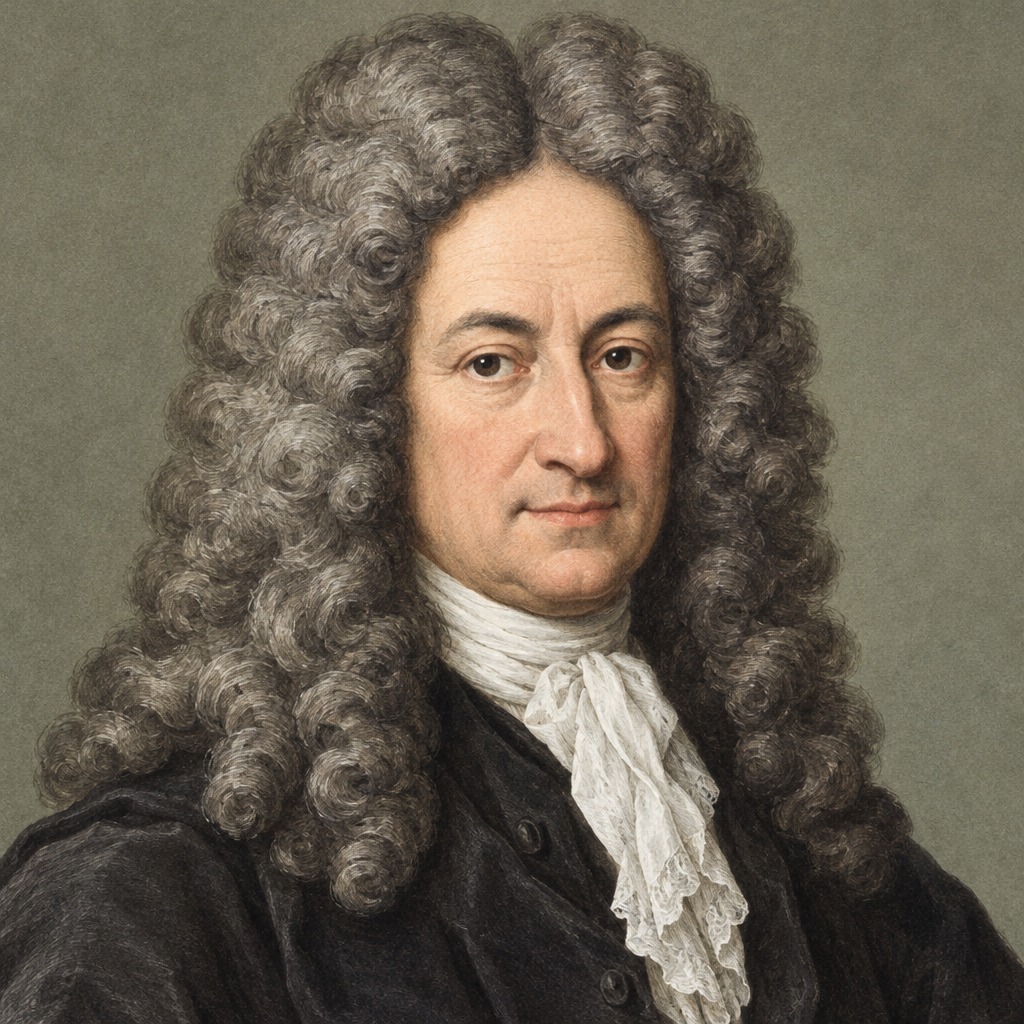
Gottfried Wilhelm Leibniz · 라이프니츠 — Hanover and Paris, 1673-1703 CE
💡 The Idea
Gottfried Wilhelm Leibniz (1646-1716) was born in Leipzig and is called the "last universal genius" by the Stanford Encyclopedia of Philosophy. In Paris he designed a calculating machine for the four basic operations, and in January 1673 he showed an unfinished machine to the Royal Society in London (MacTutor; Stanford Encyclopedia). His binary arithmetic is the main idea here. In ordinary counting we use ten signs and start again at ten. In binary, we use two signs, 0 and 1, and start again at two. So two is 10, four is 100, eight is 1000. Every whole number is a sum of these powers of two: 111 is 4 + 2 + 1 = 7, and 1101 is 8 + 4 + 1 = 13. Leibniz says he had used this system "for many years" and that, according to MacTutor, he had perfected it by 1679. His paper "Explanation of Binary Arithmetic" appeared in the Paris Academy's volume for the year 1703. He did not want it to replace ordinary counting, because the numbers are longer. He valued it because it shows a clear order, for example in the repeating patterns of each column of the table. The China story is more uncertain. In that paper, Leibniz says he sent his method to Father Joachim Bouvet in Beijing, and that Bouvet wrote on 14 November 1701 and sent him a diagram of 64 figures made of whole and broken lines, linked to Fuxi. Leibniz says Bouvet was the first to see that his method was the key to these figures, and Leibniz agreed: a whole line means 1 and a broken line means 0. This is the interpretation of two Europeans around 1700, not something the old Chinese makers of the lines told us. Fuxi is a legendary figure, and the paper itself says only that he is "believed" to have lived more than 4000 years ago. About the sources: the binary table, the examples (111, 1101), the Bouvet letter date and the reading of the lines come from Lloyd Strickland's English translation of the 1703 text, at leibniz-translations.com. The machine and the 1673 London visit come from the Stanford Encyclopedia of Philosophy and MacTutor. The name of the machine and its exact design are not covered in the sources we read, so we do not give details. He did not invent "the computer", and we did not read any source that says his machine used binary. The conversation with the "Clerk" is imagined.
고트프리트 빌헬름 라이프니츠(1646~1716)는 라이프치히에서 태어났고, 스탠퍼드 철학 백과사전은 그를 "마지막 보편적 천재"라고 불러요. 파리에서 그는 사칙연산을 위한 계산 기계를 설계했고, 1673년 1월에는 런던의 왕립학회에 아직 완성되지 않은 기계를 보여 주었어요(맥튜터, 스탠퍼드 백과사전). 이진법 산술이 여기서의 중심 생각이에요. 보통의 셈에서는 기호 열 개를 쓰고 열에서 다시 시작해요. 이진법에서는 기호 두 개, 0과 1을 쓰고 둘에서 다시 시작해요. 그래서 둘은 10, 넷은 100, 여덟은 1000이에요. 모든 자연수는 이런 2의 거듭제곱의 합이에요. 111은 4 + 2 + 1 = 7이고, 1101은 8 + 4 + 1 = 13이에요. 라이프니츠는 이 방식을 "여러 해 동안" 썼다고 말하고, 맥튜터에 따르면 1679년 무렵에는 완성했어요. 그의 글 「이진 산술 설명」은 파리 학술원의 1703년도 논문집에 실렸어요. 그는 숫자가 더 길어지기 때문에 이 방식이 보통의 셈을 대신하길 바라지 않았어요. 그가 높이 산 이유는, 표의 각 열이 되풀이되는 무늬를 보이듯이 분명한 질서가 드러나기 때문이에요. 중국 이야기는 더 불확실해요. 그 글에서 라이프니츠는 베이징의 조아킴 부베 신부에게 자기 방법을 보냈고, 부베가 1701년 11월 14일에 답장하며 복희와 연결되는, 온전한 선과 끊어진 선으로 된 64개의 도형을 보내 주었다고 말해요. 라이프니츠는 자기 방법이 이 도형을 푸는 열쇠라는 것을 부베가 먼저 알아보았다고 말하고, 자신도 동의했어요. 온전한 선은 1, 끊어진 선은 0이라는 거예요. 이것은 1700년 무렵 두 유럽인의 해석이지, 옛날 그 선을 만든 중국 사람들이 알려 준 것이 아니에요. 복희는 전설적 인물이고, 글 자체도 그가 4000년도 더 전에 살았다고 "믿어진다"고만 말해요. 출처에 대해: 이진법 표, 예시(111, 1101), 부베 편지의 날짜, 선을 읽는 방식은 로이드 스트릭랜드가 영어로 옮긴 1703년 글(leibniz-translations.com)에서 가져왔어요. 기계와 1673년 런던 방문은 스탠퍼드 철학 백과사전과 맥튜터에서 가져왔어요. 기계의 이름과 정확한 설계는 우리가 읽은 자료에 없어서 자세히 말하지 않았어요. 그는 "컴퓨터"를 발명하지 않았고, 그의 기계가 이진법을 썼다고 말하는 자료는 읽지 못했어요. '점원'과의 대화는 상상한 것이에요.
📚 Grammar focus
Second conditional (if + past simple, would + base verb)
✏️ Try it
Part 1: Write each number in binary (use only 0 and 1). Hint: add powers of two: 1, 2, 4, 8, 16. 1. Three 2. Five 3. Six 4. Nine Part 2: Read these binary numbers and write the usual number. 5. 111 6. 1101 7. 10000 Part 3: Complete each second-conditional sentence with the correct form. 8. If I _______ (have) only two signs, I _______ (write) numbers with 0 and 1. 9. If Leibniz _______ (be) here today, he _______ (see) digital machines everywhere. 10. What _______ you _______ (do) if you _______ (find) an old diagram?
전체 레슨을 보고 싶으세요?
Want the full lesson?
회화 연습, 역할극, 문법, 그리고 진짜 선생님이 안에 있어요.
Conversation practice, roleplay, grammar, and a real tutor are inside.