Eureka! · No. 65
The Idea I Can Live For
그것을 위해 살 수 있는 생각
Søren Kierkegaard · 쇠렌 키르케고르 — Copenhagen, Denmark, 1835-1844 CE
💡 The Idea
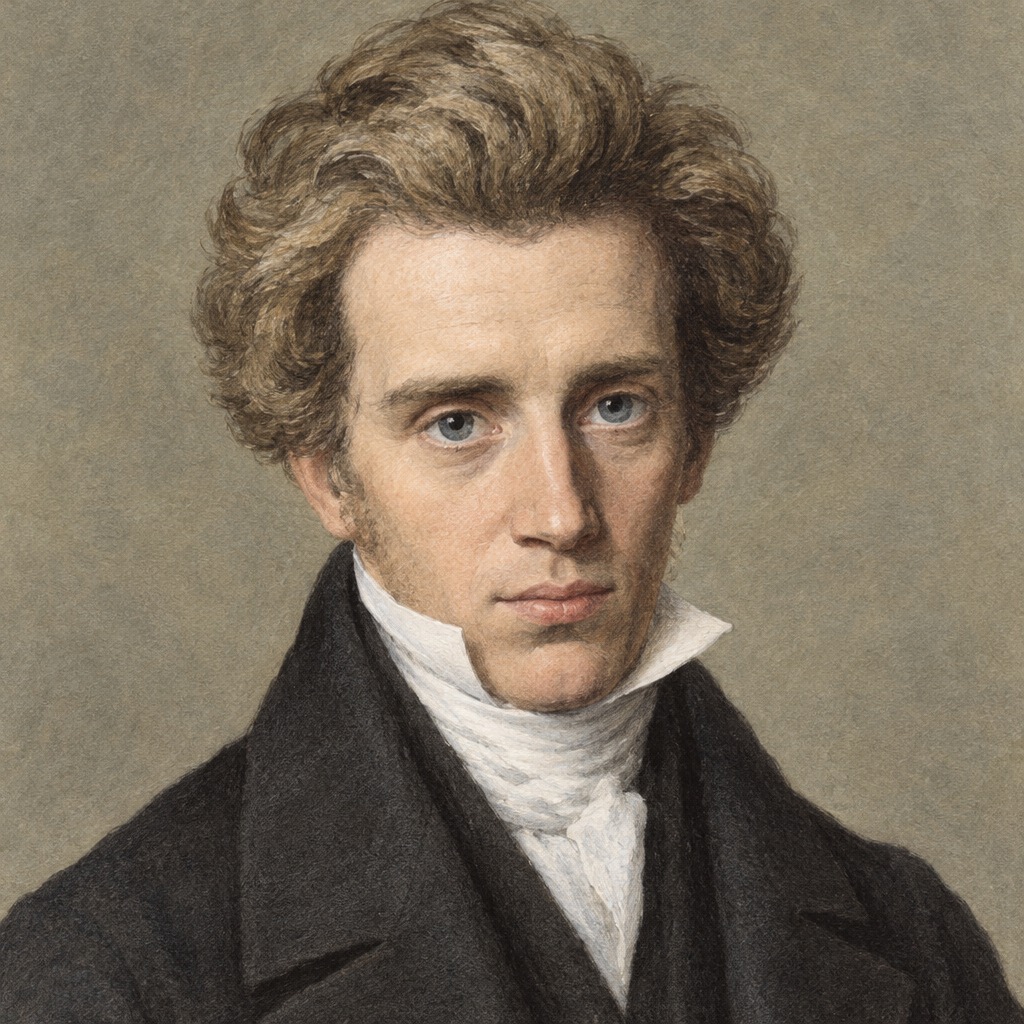
Søren Kierkegaard (1813-1855) was born in Copenhagen on 5 May 1813 and died on 11 November 1855. According to the Stanford Encyclopedia of Philosophy, he wrote most of his work in the 1840s, and both encyclopedias note that he is often called "the father of existentialism" (the Stanford Encyclopedia warns that the label can mislead). His central idea is that a person must choose and live his or her own life. Facts and systems can help, but they cannot decide for us. In the journal of 1 August 1835 (Gilleleie), the 22-year-old writes that he needs to find "a truth which is true for me ... the idea for which I can live and die" (wording from one English translation; translators differ). Later, under another pen name (1846), he says that thinking alone cannot lead to a choice. The Stanford Encyclopedia says that a person must want to stop the endless process of reflection and commit to a possibility. In The Concept of Anxiety (1844), written under the pseudonym Vigilius Haufniensis, anxiety is "the dizziness of freedom". Anxiety is not just a sickness. It is an awareness of freedom: we are pulled toward our possibilities and also afraid of them, like a person who looks down from a great height. The Internet Encyclopedia of Philosophy uses the same comparison with vertigo. About the sources: the dates, the quotation "the dizziness of freedom", the book titles and the reading of anxiety come from the Stanford Encyclopedia and the Internet Encyclopedia of Philosophy. The Gilleleie wording shown here appears on several websites as an English translation (in one Hong translation it reads "a truth which is truth for me ... the idea for which I am willing to live and die"); we could not check the page of a printed edition, so we call it "one English translation". The conversation with the "Friend" is imagined: a journal has only one writer. His religious thought, the break with Regine and his attack on the Church are for another unit.
쇠렌 키르케고르(1813~1855)는 1813년 5월 5일 코펜하겐에서 태어나 1855년 11월 11일에 세상을 떠났어요. 스탠퍼드 철학 백과사전에 따르면 그는 대부분의 저작을 1840년대에 썼고, 두 백과사전 모두 그가 흔히 "실존주의의 아버지"라고 불린다고 적어요(스탠퍼드 철학 백과사전은 이 이름이 오해를 낳을 수 있다고 덧붙여요). 그의 중심 생각은 사람이 자기 삶을 직접 선택하고 살아야 한다는 거예요. 사실과 체계는 도움이 될 수 있지만 우리 대신 결정해 주지는 못해요. 1835년 8월 1일 일기(길레라이에)에서 스물두 살의 그는 "내게 참인 진리, ... 내가 그것을 위해 살고 죽을 수 있는 생각"을 찾아야 한다고 써요(한 영어 번역의 표현이며 번역자마다 달라요). 훗날 그는 다른 가명(1846)으로 생각만으로는 선택에 이를 수 없다고 말해요. 스탠퍼드 철학 백과사전은, 끝없는 성찰의 과정을 멈추고 하나의 가능성에 몸을 맡기려는 의지가 있어야 한다고 말해요. 『불안의 개념』(1844)은 빅길리우스 하우프니엔시스라는 가명으로 썼는데, 여기서 불안은 "자유의 현기증"이에요. 불안은 단순한 병이 아니에요. 자유를 의식하는 것이에요. 우리는 가능성에 끌리면서 동시에 그것을 두려워해요. 높은 곳에서 내려다보는 사람처럼요. 인터넷 철학 백과사전도 현기증에 비유해요. 출처에 대해: 날짜, "자유의 현기증"이라는 표현, 책 제목, 불안에 대한 설명은 스탠퍼드 철학 백과사전과 인터넷 철학 백과사전에서 가져왔어요. 여기 실은 길레라이에 일기의 문장은 여러 웹사이트에 영어 번역으로 나와 있어요(하워드·에드나 홍 부부의 번역본은 "a truth which is truth for me ... the idea for which I am willing to live and die"라고 되어 있어요). 인쇄본의 쪽수를 직접 확인하지는 못해서 "한 영어 번역"이라고 적었어요. '친구'와의 대화는 상상한 것이에요. 일기에는 쓰는 사람이 한 명뿐이기 때문이에요. 그의 종교 사상, 레기네와의 이별, 교회에 대한 공격은 다른 단원에서 다뤄요.
📚 Grammar focus
Wishes (I wish + past simple / past perfect)
✏️ Try it
Complete each sentence with the correct form of the verb in brackets. 1. I wish I _______ (know) the answer to this question. (I do not know it now.) 2. I wish I _______ (be) braver. (I am not brave.) 3. Søren wishes he _______ (can) borrow someone else's life. 4. I wish I _______ (study) harder last month. (I did not study.) 5. Do you wish you _______ (choose) a different school? Bonus: Write two sentences about your life. Use "I wish I ..." for something now and "I wish I had ..." for something in the past.
전체 레슨을 보고 싶으세요?
Want the full lesson?
회화 연습, 역할극, 문법, 그리고 진짜 선생님이 안에 있어요.
Conversation practice, roleplay, grammar, and a real tutor are inside.