Eureka! · No. 84
Check the Numbers by Hand
숫자를 손으로 직접 확인하라
Katherine Johnson · 캐서린 존슨 — NASA Langley, Virginia, 1962
💡 The Idea
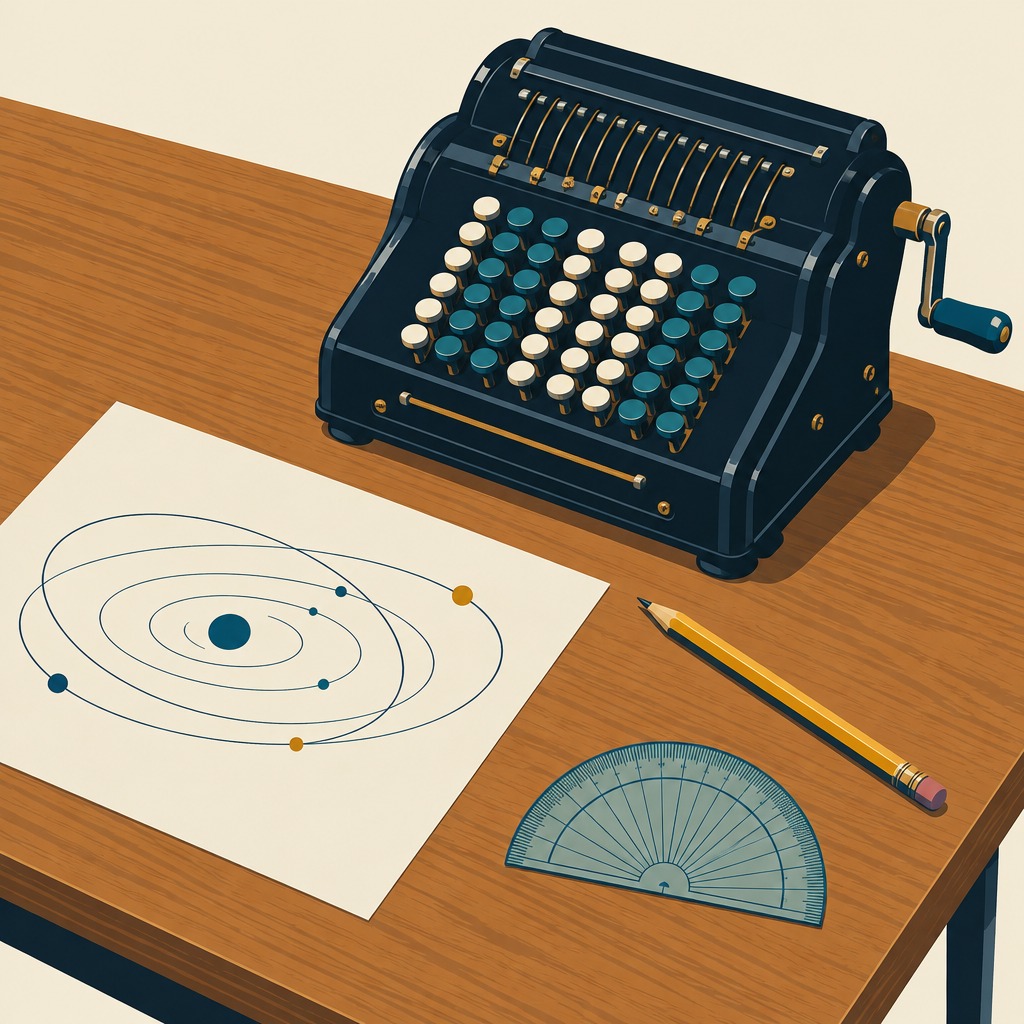
Katherine Johnson was born on 26 August 1918 in White Sulphur Springs, West Virginia. She was very good at mathematics and moved ahead of her classmates at school. At West Virginia State College she studied mathematics with Professor W. W. Schieffelin Claytor, and she graduated in 1937 with highest honors, with degrees in mathematics and French. (NASA's pages disagree on her exact age at some points, so this unit gives years only.) In 1939 West Virginia quietly opened its graduate schools to Black students. Johnson was one of three Black students chosen, but she left the program after the first session to start a family. In 1952 a relative told her about jobs at the National Advisory Committee for Aeronautics (NACA), the agency before NASA. The job was in the West Area Computing section at Langley, headed by Dorothy Vaughan. In those years "computers" were people who did calculations by hand and with simple machines. At that time the United States was segregated by race, and West Area Computing was an all-Black unit. Two weeks after she started in 1953, she was assigned to a flight research group, and her job became permanent. She analyzed flight-test data for about four years. She also asked to attend the engineers' briefings, and, according to NASA, she was told that women did not go. She asked if a law said so. None did. After Sputnik, Johnson moved into space work. She did trajectory analysis for Alan Shepard's flight in May 1961. A trajectory is the path of a flying object. Then, in 1962, NASA prepared John Glenn's orbital flight. The computers were new and the astronauts were careful. NASA's biography says that Glenn asked the engineers to "get the girl", and that Johnson ran the numbers by hand on a desktop calculating machine. It also says that she remembered Glenn saying that her answer would decide whether he was ready. This is her memory told in NASA's biography, and not a recorded sentence, so this unit does not treat it as exact words. A NASA image page says that she is credited with verifying the early computers' calculations for Glenn's flight and for the Apollo 11 trajectory. She said that her greatest contribution was the calculations that helped connect the Apollo Lunar Module with the Command and Service Module in lunar orbit. She wrote or co-wrote 26 research reports and retired in 1986. On 24 November 2015, President Barack Obama gave her the Presidential Medal of Freedom, and she died on 24 February 2020. NASA calls her one of the "Hidden Figures", and Margot Lee Shetterly, the author of the book Hidden Figures, wrote NASA's biography of her. Segregation affected her life and her work. The sources tell us what the rules were, and they tell us that Johnson kept asking questions. About the sources: all facts come from NASA pages (the Katherine Johnson biography, the NASA STEM profile, a NASA page about Dorothy Vaughan, and NASA image and news pages). The conversation is imagined.
캐서린 존슨은 1918년 8월 26일 웨스트버지니아주 화이트설퍼스프링스에서 태어났어요. 수학을 아주 잘했고 학교에서 또래보다 앞서 나갔어요. 웨스트버지니아 주립대학에서 W. W. 스키필린 클레이터 교수에게 수학을 배웠고, 1937년에 수학과 프랑스어 학위를 받으며 최우등으로 졸업했어요. (NASA의 글들은 그녀의 나이를 말하는 부분에서 서로 달라서, 이 단원은 연도만 적었어요.) 1939년에 웨스트버지니아주는 대학원을 흑인 학생에게 조용히 열었어요. 존슨은 뽑힌 흑인 학생 세 명 중 한 명이었지만, 첫 학기를 마친 뒤 가정을 꾸리려고 과정을 떠났어요. 1952년에 한 친척이 NASA의 전신인 미국 항공자문위원회(NACA)의 일자리를 알려 주었어요. 그 일은 랭글리의 '웨스트 에어리어 컴퓨팅' 부서였고, 도로시 본이 이끌고 있었어요. 그 시절 '컴퓨터'는 손과 간단한 기계로 계산을 하는 사람을 가리켰어요. 당시 미국은 인종에 따라 분리된 사회였고, 웨스트 에어리어 컴퓨팅은 흑인만 따로 모아 놓은 조직이었어요. 1953년에 일을 시작하고 2주 뒤, 그녀는 비행 연구 그룹에 배정되었고 임시직은 곧 정규직이 되었어요. 그녀는 약 4년 동안 비행 시험 자료를 분석했어요. 또 엔지니어들의 회의에 참석하겠다고 했고, NASA에 따르면 여성은 가지 않는다는 말을 들었어요. 그녀는 그렇게 정한 법이 있느냐고 물었어요. 그런 법은 없었어요. 스푸트니크 이후 존슨은 우주 일로 옮겨 갔어요. 1961년 5월에는 앨런 셰퍼드의 비행을 위한 궤도 분석을 했어요. 궤도(trajectory)는 날아가는 물체가 지나가는 길이에요. 그리고 1962년에 NASA는 존 글렌의 지구 궤도 비행을 준비했어요. 컴퓨터는 새것이었고 우주비행사들은 조심스러워했어요. NASA의 인물 소개는 글렌이 엔지니어들에게 "그 여자를 데려오라"고 했고, 존슨이 탁상용 계산기로 숫자를 손으로 계산했다고 말해요. 또 존슨이 글렌이 그녀의 답에 따라 준비가 되었는지 정하겠다고 말한 것으로 기억한다고도 해요. 이것은 NASA의 인물 소개에 실린 그녀의 기억이지 녹음된 문장이 아니어서, 이 단원은 정확한 말로 다루지 않아요. NASA의 한 이미지 페이지는 그녀가 글렌의 비행과 아폴로 11호 궤도에 대해 초기 컴퓨터의 계산을 검증한 것으로 인정받는다고 말해요. 그녀 자신은 가장 큰 공헌이 달 궤도에서 아폴로 달착륙선과 사령선 및 서비스 모듈을 연결하는 데 도움이 된 계산이라고 말했어요. 그녀는 연구 보고서 26편을 쓰거나 공동으로 썼고 1986년에 은퇴했어요. 2015년 11월 24일에 버락 오바마 대통령이 그녀에게 대통령 자유 훈장을 주었고, 그녀는 2020년 2월 24일에 세상을 떠났어요. NASA는 그녀를 '히든 피겨스' 중 한 사람이라고 부르고, 책 『히든 피겨스』를 쓴 마고 리 셰털리가 NASA의 그녀 인물 소개를 썼어요. 인종 분리는 그녀의 삶과 일에 영향을 주었어요. 자료들은 그때의 규칙이 어땠는지를 알려 주고, 존슨이 계속 질문했다는 것도 알려 줘요. 출처에 대해: 모든 사실은 NASA 자료(캐서린 존슨 인물 소개, NASA STEM 소개글, 도로시 본에 관한 NASA 페이지, NASA의 사진과 보도 자료 페이지)에서 가져왔어요. 대화는 상상한 것이에요.
📚 Grammar focus
Second conditional (imagined situations: if + past simple, would + verb)
✏️ Try it
Complete each sentence with the second conditional (if + past simple, would + verb). 1. If the computer _______ (make) a mistake, the capsule _______ (land) in the wrong place. 2. If I _______ (be) the astronaut, I _______ (want) someone to check the numbers. 3. What _______ you _______ (do) if your answer _______ (be) different from the computer's? 4. If you _______ (not / ask) questions, you _______ (not / learn) very much. 5. If you _______ (have) a hand calculator today, which problem _______ you _______ (solve) first? 6. If I _______ (be) in Johnson's place, I _______ (ask) the same question. Bonus: Write two sentences about your life. Use "If I were ..., I would ..." and "If I could ..., I would ...".
전체 레슨을 보고 싶으세요?
Want the full lesson?
회화 연습, 역할극, 문법, 그리고 진짜 선생님이 안에 있어요.
Conversation practice, roleplay, grammar, and a real tutor are inside.