Eureka! · No. 46
A Clock That Rings by Itself
스스로 소리를 내는 시계
Jang Yeong-sil · 장영실 — Joseon, 1434
💡 The Idea
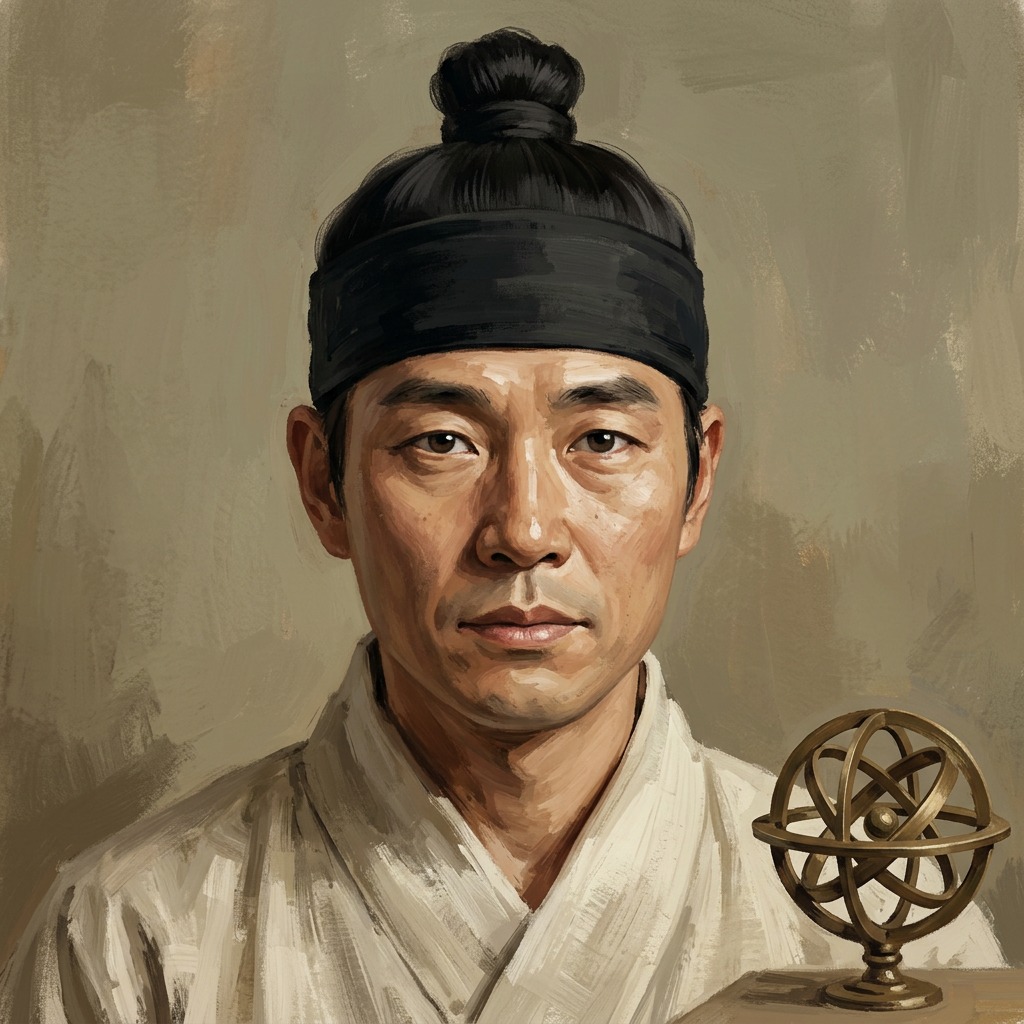
Jang Yeong-sil lived in Joseon Korea. We do not know when he was born or when he died. The Encyclopedia of Korean Culture gives no birth year, and the year "about 1390" in some books is only an estimate. The Sejong Sillok says his father was from the Suzhou and Hangzhou area of China and his mother was a gisaeng. The Encyclopedia of Korean Culture says he was a government slave (gwanno) of Dongnae county. The National Archives of Korea quotes the Sejong Sillok: he was skilful and had long worked as a craftsman for the palace. King Sejong wanted to appoint him to a post at the Sanguiwon, but the minister Heo Jo strongly opposed it because he was a gisaeng's son. The Sillok says the king first tried to appoint him in about 1422-1423, and appointed him after asking the ministers again. The Encyclopedia says he was freed after he came back from China and was appointed in 1423. The invention at the heart of this unit is the Jagyeongnu, an automatic water clock. In the ninth lunar month of 1433 the king said that Jang had made a self-striking water clock and that it could not have been made without him, and he gave Jang the fourth-rank post of hogun. The Korea Astronomy and Space Science Institute and the Encyclopedia of Korean Culture say it was made by Jang Yeong-sil and Kim Bin in 1434; in the Sillok, Kim Bin is the official who wrote its inscription. The Sejong Sillok describes how it worked: wooden puppets struck a bell for the hours and a drum and a gong for the night watches. The Sillok says that from the first day of the seventh lunar month of 1434 the new water clock was used, and it was kept in a building named the Borugak. The original was not preserved. Water jars of a later rebuilt clock remain. The idea is not only technology. It is a clock that strikes the hours by itself. It is also a story about talent and class. Sejong wanted to give a place at court to a man of very low birth. What happened later is quiet and sad. The Sejong Sillok says that on the sixteenth day of the third lunar month of 1442 a royal sedan chair that Jang had overseen was not made strongly enough and broke, so he was sent to the royal court of justice for questioning. On the twenty-seventh day of the fourth lunar month, the court asked for a punishment of 100 strokes of the stick, and the king made it two degrees lighter. No records of his later life remain. About the sources: we read the Sejong Sillok articles directly on the Annals of the Joseon Dynasty website (15th year 9th month 16th day; 16th year 7th month 1st day; 24th year 3rd month 16th day; 24th year 4th month 27th day, all lunar dates). Other details come from the Encyclopedia of Korean Culture, the National Archives of Korea and KASI. The rain gauge of 1441 is often credited to Jang, but historians say no historical record names him as its inventor; it was made under Crown Prince Yi Hyang, the later King Munjong, so it is not part of this unit. The conversation is dramatized, and we use no real quotations from Jang.
장영실은 조선 시대 사람이에요. 언제 태어나고 언제 세상을 떠났는지는 알 수 없어요. 한국민족문화대백과사전에는 출생 연도가 없고, 일부 책에 나오는 '1390년경'은 추정일 뿐이에요. 《세종실록》에 따르면 그의 아버지는 중국 소주·항주 지역 사람이었고 어머니는 기생이었어요. 한국민족문화대백과사전에 따르면 그는 동래현의 관노였어요. 국가기록원은 《세종실록》을 인용해 그가 솜씨가 정교해 오랫동안 궁궐의 장인으로 일했다고 전해요. 세종은 그를 상의원의 관직에 임명하려 했지만, 이조판서 허조가 기생의 아들이라며 크게 반대했어요. 《세종실록》에 따르면 세종은 1422~1423년 무렵 처음 그를 임명하려 했고, 대신들에게 다시 의논한 뒤 임명했어요. 한국민족문화대백과사전은 그가 중국에서 돌아온 뒤 면천되어 1423년에 임명되었다고 써요. 이 단원의 중심 발명품은 자동 물시계 자격루예요. 1433년 음력 9월에 세종은 장영실이 스스로 치는 물시계를 만들었고 그가 아니었다면 만들지 못했을 것이라고 말하며, 그에게 4품 벼슬인 호군을 주었어요. 한국천문연구원과 한국민족문화대백과사전은 자격루를 1434년에 장영실과 김빈이 만들었다고 설명해요. 《세종실록》에서 김빈은 이 시계에 새길 글(명)을 지은 관리로 나와요. 《세종실록》에 따르면 나무 인형이 종을 쳐서 시(時)를 알리고, 북과 징을 쳐서 밤의 경(更)과 점(點)을 알렸어요. 《세종실록》은 1434년 음력 7월 1일부터 새 물시계를 쓰기 시작했고, 그 집을 보루각이라고 이름 지었다고 적어요. 원래의 시계는 남아 있지 않고, 나중에 다시 만든 시계의 물 항아리들이 남아 있어요. 이 생각은 기술만의 이야기가 아니에요. 시각을 스스로 쳐서 알리는 시계예요. 재능과 신분에 대한 이야기이기도 해요. 세종은 아주 낮은 신분으로 태어난 사람에게 궁궐의 자리를 주려고 했어요. 그 뒤의 일은 조용하고 슬퍼요. 《세종실록》에 따르면 1442년 음력 3월 16일 장영실이 감독해 만든 임금의 가마(안여)가 튼튼하지 못해 부러졌고, 그는 의금부로 보내져 조사를 받았어요. 음력 4월 27일 의금부는 곤장 100대의 벌을 청했고, 임금은 두 등급을 줄여 주었어요. 그 뒤의 삶에 대한 기록은 남아 있지 않아요. 출처에 대해: 《세종실록》 기사는 조선왕조실록 누리집에서 직접 읽었어요(세종 15년 9월 16일, 16년 7월 1일, 24년 3월 16일, 24년 4월 27일, 모두 음력). 다른 내용은 한국민족문화대백과사전, 국가기록원, 한국천문연구원 자료에서 가져왔어요. 1441년의 측우기는 흔히 장영실의 발명으로 알려져 있지만, 학자들은 어떤 사료에도 그가 발명자라고 나오지 않는다고 말해요. 측우기는 훗날 문종이 되는 세자 이향 아래에서 만들어졌어요. 그래서 이 단원에서는 다루지 않아요. 대화는 극으로 꾸민 것이고, 장영실의 실제 말을 인용하지 않아요.
📚 Grammar focus
Passive voice, past simple (was / were + past participle)
✏️ Try it
Change each sentence to the passive voice (past simple). 1. Kim Bin and Jang built the clock. → The clock _______ _______ by Kim Bin and Jang. 2. Someone sent Jang to China. → Jang _______ _______ to China. 3. People installed the clock in the palace. → The clock _______ _______ in the palace. 4. The king freed Jang. → Jang _______ _______ . 5. Make a question: the clock / use / as the standard? → _______ the clock _______ as the standard? Bonus: Write two sentences about things that were made in your country. Use "was made" or "were built".
전체 레슨을 보고 싶으세요?
Want the full lesson?
회화 연습, 역할극, 문법, 그리고 진짜 선생님이 안에 있어요.
Conversation practice, roleplay, grammar, and a real tutor are inside.