Eureka! · No. 80
A Naval Base to Close the Sea Road
바닷길을 지키는 해군 기지
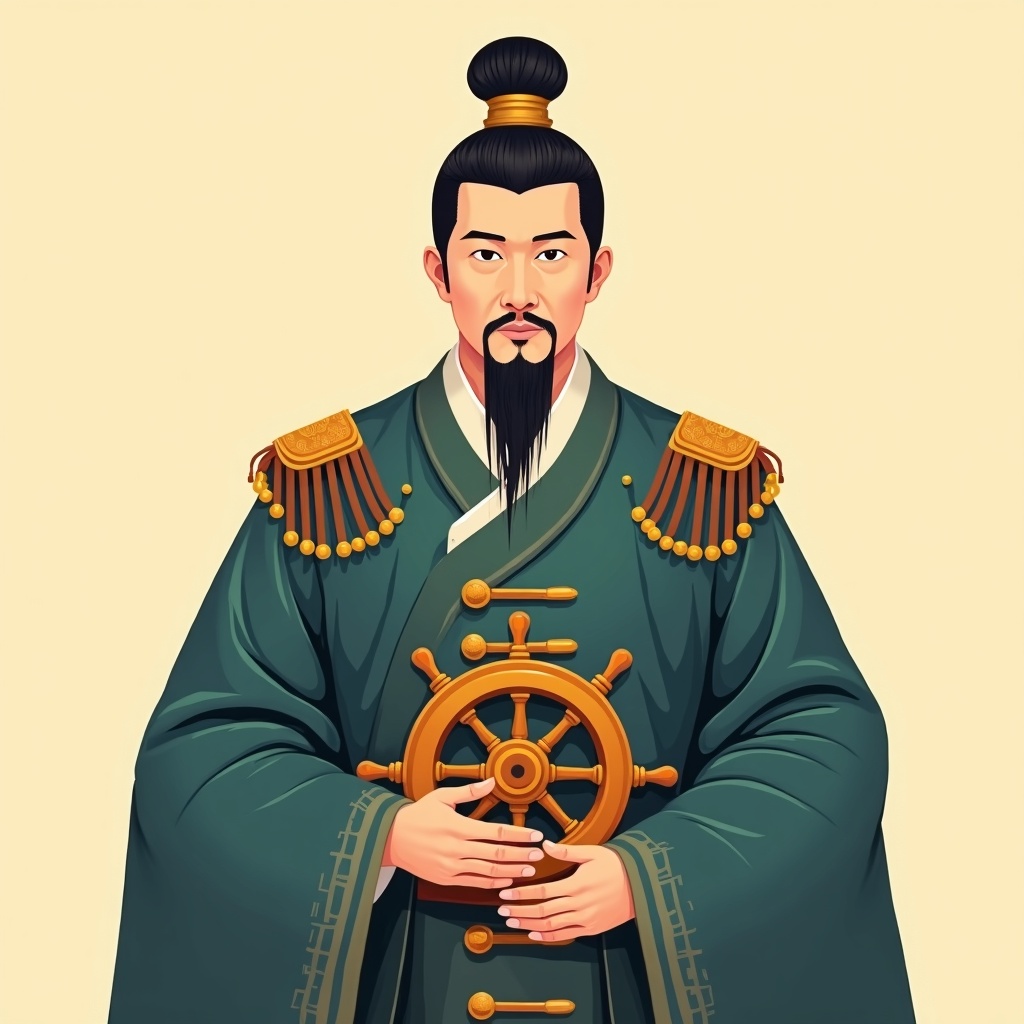
Jang Bogo · 장보고 — Cheonghaejin on Wando island, Silla (Korea), about 828
💡 The Idea
Jang Bogo (張保皐) was a man of Silla, a kingdom in the south-east of the Korean peninsula. His childhood name was Gungbok (弓福) or Gungpa. The Encyclopedia of Korean Culture says Gungbok means "a person who shoots a bow well" and that he was probably a commoner. His birth year is not known. (Some websites give 787 or "about 790", but our two encyclopedia entries say only "unknown", so we do not give a birth year.) We also could not find a firm source for the usual claim that he was "from Wando". The sources say only that he came from a coastal area; the base was built on Wando. In China: as a young man he went to Tang China with his friend Jeong Nyeon. The encyclopedia says he served in the Wuning army at Xuzhou and became an officer. Many Silla people lived along China's east coast, and some of them were traders or shippers. The encyclopedia says that around this time pirates took Silla people and sold them as slaves in China. Another English-language summary mentions an edict of 823 by the Tang emperor that ordered the slave trade to stop. Cheonghaejin: Jang Bogo came back to Silla in 828 (the third year of King Heungdeok). He asked the king to let him build a naval base at Wando, to protect the trade routes on the Yellow Sea and to remove the pirates. The king agreed, and Jang Bogo gathered local people into a kind of citizen army of about 10,000 men. The base was called Cheonghaejin (清海鎭, "clear sea garrison"). The commander's title, Cheonghaejin Daesa (清海鎭大使), was not in the usual Silla list of offices. The base stood on and around Jang Island (Jangdo), off the town of Wando. A lookout tower stood there, and wooden posts, about ten centimetres apart, stood around the island to stop ships from coming near. Trade and influence: the encyclopedia says that after the pirates were gone, Jang Bogo led trade between Tang, Silla and Japan. A trade mission (hoeyeoksa) that he sent to Japan in 840 is recorded in the Japanese Shoku Nihon Koki. He also built and supported a Silla temple, Beophwawon (法華院), in Jeoksan village (Chishan in Chinese) in Shandong, which had more than 30 monks and, at some ceremonies, 250 people. The same encyclopedia says that the Japanese monk Ennin, who wrote the travel diary Nittō guhō junrei kōki, wrote to Jang Bogo for help on his journey home. We did not read the diary: the Reischauer translation is only available to borrow online. Politics and the end: in 836 a Silla prince, Kim Ujing (金祐徵), who had lost a fight for the throne, came to Cheonghaejin. In 838 another change of king happened in the capital. Jang Bogo sent about 5,000 men with Jeong Nyeon and others, and in 839 Kim Ujing became King Sinmu. The king gave Jang Bogo the title Gamui gunsa (感義軍使) and 2,000 households of income. Then the nobles refused to let Jang Bogo's daughter become the next king's wife, and the central government and Cheonghaejin grew apart. The encyclopedia says that Yeom Jang, once Jang Bogo's own officer, pretended to join him, was welcomed at a feast, and then killed him. The encyclopedia entries on Jang Bogo and Cheonghaejin give 846 for his death; this is the year in the Samguk Sagi. The National Institute of Korean History (New History of Korea) gives 841, using the Japanese Shoku Nihon Koki, Ennin's diary and other records. We did not read those original texts ourselves, so we write "in the 840s". Cheonghaejin was closed in 851 and its people were moved to Byeolgol (now Gimje). Date warning: old Korean records use the king's year (for example, "the third year of King Heungdeok") and the lunar calendar, so a conversion to a Western year can be off by one. About the story: all talk lines are imagined. The facts are from the Encyclopedia of Korean Culture (the entries on Jang Bogo, Cheonghaejin, Yeom Jang, Jeong Nyeon, Hoeyeoksa and Gamui gunsa), the National Institute of Korean History for the 841 date, and one English summary for the 823 edict.
장보고(張保皐)는 한반도 남동쪽에 있던 왕국 신라 사람이에요. 어릴 적 이름은 궁복(弓福) 또는 궁파예요. 한국민족문화대백과사전은 궁복이 '활을 잘 쏘는 사람'이라는 뜻이고 그가 평민 출신이었을 것으로 보인다고 말해요. 태어난 해는 알려져 있지 않아요. (어떤 웹사이트는 787년이나 "790년경"이라고 쓰지만 우리가 본 대백과사전 두 항목은 '미상'이라고만 해서, 출생 연도는 쓰지 않았어요.) 흔히 말하는 "완도 출신"이라는 주장도 확실한 자료를 찾지 못했어요. 자료들은 그가 해안 지역 출신이라고만 말하고, 기지는 완도에 세워졌어요. 중국에서는 이래요. 젊은 장보고는 친구 정년과 당나라로 건너갔어요. 대백과사전은 그가 서주의 무령군에서 복무해 장교가 되었다고 말해요. 많은 신라 사람이 중국 동쪽 해안을 따라 살았고 그중 일부는 상인이나 선주였어요. 대백과사전은 이 무렵 해적이 신라 사람을 잡아가 중국에 노예로 팔았다고 해요. 다른 영어 요약은 당나라 황제가 823년에 노예 거래를 멈추라는 칙령을 내렸다고 말해요. 청해진은 이래요. 장보고는 828년(흥덕왕 3년)에 신라로 돌아왔어요. 그는 황해의 무역로를 지키고 해적을 없앨 수 있도록 완도에 해군 기지를 세우게 해 달라고 왕에게 청했어요. 왕은 허락했고, 장보고는 지역 사람들을 모아 약 1만 명의 민병 조직을 만들었어요. 기지의 이름은 청해진(淸海鎭, '맑은 바다의 진영')이에요. 책임자의 직함인 청해진대사(淸海鎭大使)는 신라의 보통 관직 목록에는 없었어요. 기지는 완도읍 앞 장도(將島)와 그 둘레에 있었고, 망대가 서 있었으며, 섬 둘레에는 약 10센티미터 간격으로 나무 말뚝을 박아 배가 가까이 오지 못하게 했어요. 무역과 영향력은 이래요. 대백과사전은 해적이 사라진 뒤 장보고가 당나라, 신라, 일본 사이의 무역을 이끌었다고 해요. 그가 840년에 일본으로 보낸 무역 사절(회역사)은 일본 기록 《속일본후기》에 나와요. 그는 중국 산둥의 적산촌에 있던 신라 절 법화원(法華院)도 도왔는데, 이 절에는 승려가 30명이 넘었고 어떤 법회에는 250명이 모였어요. 같은 대백과사전은 《입당구법순례행기》라는 여행 일기를 쓴 일본 승려 엔닌이 귀국길에 도움을 청하려고 장보고에게 편지를 썼다고 해요. 일기 자체는 읽지 못했어요. 라이샤워의 번역본은 온라인에서 대출만 되기 때문이에요. 정치와 최후는 이래요. 836년에 왕위 다툼에서 진 신라 왕자 김우징이 청해진으로 왔어요. 838년에 수도에서 또 왕이 바뀌는 일이 일어났고, 장보고는 정년 등과 함께 약 5천 명의 군사를 보냈어요. 839년에 김우징은 신무왕이 되었어요. 왕은 장보고에게 감의군사(感義軍使)라는 직함과 2천 호의 식읍을 주었어요. 그 뒤 귀족들이 장보고의 딸이 다음 왕의 아내가 되는 것을 반대했고, 중앙 정부와 청해진은 멀어졌어요. 대백과사전은 한때 장보고의 부하였던 염장이 거짓으로 그에게 투신해 잔치에서 환영받은 뒤 그를 죽였다고 해요. 장보고 항목과 청해진 항목은 그의 죽음을 846년이라고 하는데, 이는 《삼국사기》의 연도예요. 국사편찬위원회의 《신편 한국사》는 《속일본후기》, 엔닌의 일기 등을 근거로 841년이라고 해요. 우리는 그 원문을 직접 읽지 못해서 '840년대'라고 적었어요. 청해진은 851년에 없어졌고 그곳 사람들은 벽골(지금의 김제)로 옮겨졌어요. 날짜에 대한 주의: 옛 한국 기록은 왕의 연호(예: 흥덕왕 3년)와 음력을 쓰기 때문에 서양 연도로 바꾸면 1년쯤 어긋날 수 있어요. 이야기에 대해: 대화는 모두 상상이에요. 사실은 한국민족문화대백과사전(장보고, 청해진, 염장, 정년, 회역사, 감의군사 항목)에서, 841년이라는 날짜는 국사편찬위원회 《신편 한국사》에서, 823년 칙령은 영어 요약 하나에서 가져왔어요.
📚 Grammar focus
Second conditional (if + past simple, would / could + verb)
✏️ Try it
Finish the sentences with the correct form. 1. If Jang Bogo (have) _______ no base, the pirates (take) _______ more people. 2. If I (be) _______ the king, I (let) _______ him build the base. 3. The merchants (feel) _______ safer if the sea (be) _______ free of pirates. 4. What (you / do) _______ if you (be) _______ a Silla merchant at that time? 5. If the king's army (come) _______ faster, Jang Bogo (not need) _______ to gather his own men. Bonus: Write two sentences about yourself: "If I had ..., I would ..." and "If I were ..., I could ...".
전체 레슨을 보고 싶으세요?
Want the full lesson?
회화 연습, 역할극, 문법, 그리고 진짜 선생님이 안에 있어요.
Conversation practice, roleplay, grammar, and a real tutor are inside.