Eureka! · No. 9
A Falling Apple and a Very Big Question
떨어지는 사과와 아주 큰 질문
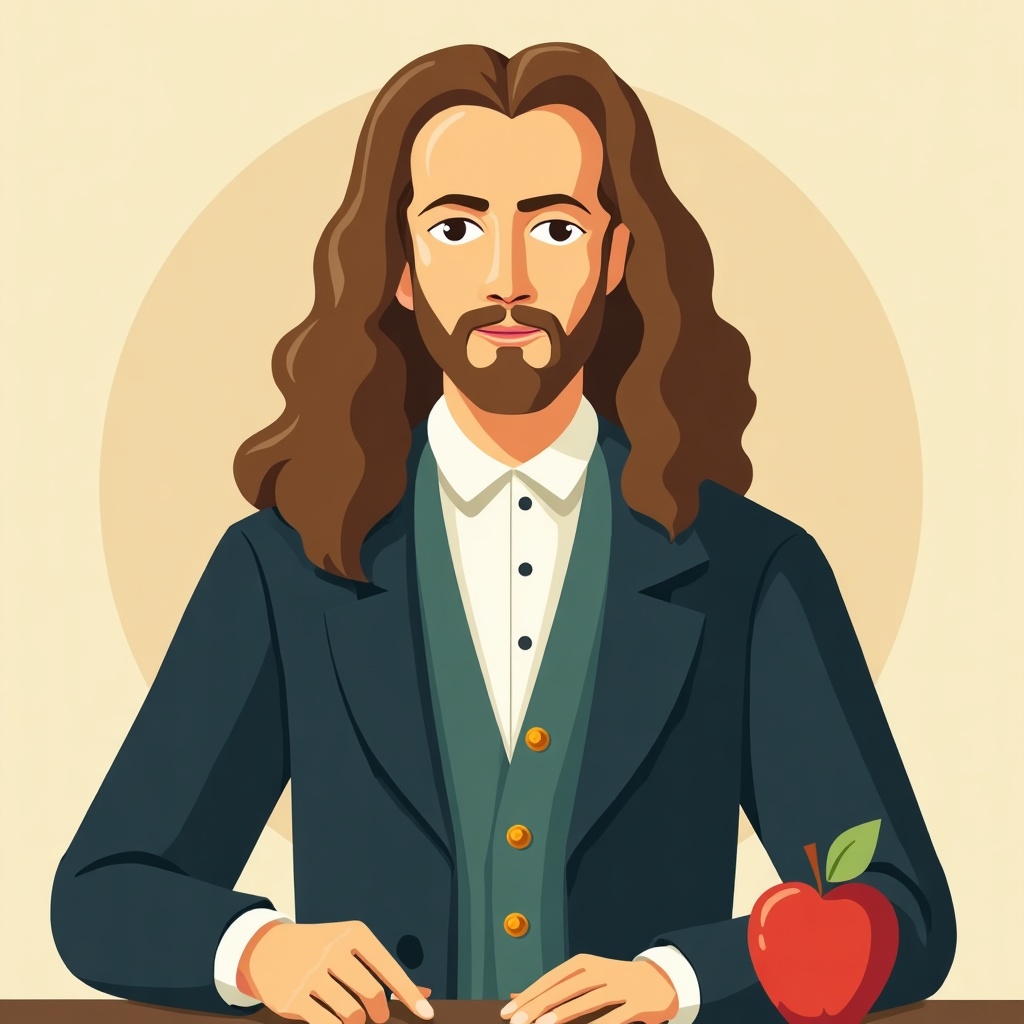
Isaac Newton · 아이작 뉴턴 — Woolsthorpe, England, 1666 CE
💡 The Idea
Newton's great insight was that gravity is not just a local Earth force — it is universal. Every object that has mass attracts every other object that has mass. The apple and the Earth pull each other. The Moon and the Earth pull each other. The planets and the Sun pull each other. The strength of this force follows an inverse-square law: F = G · m₁ · m₂ / r² F = gravitational force between two objects m₁ and m₂ = the masses of the two objects r = the distance between their centres G = the gravitational constant Double the distance (r × 2) and the force drops to one quarter (F ÷ 4). Triple the distance and the force drops to one ninth. The force weakens fast — but it never reaches exactly zero. Gravity has infinite range. Before Newton, the heavens and the Earth were thought to obey completely different rules. Newton unified them: one law, everywhere, always.
뉴턴의 위대한 통찰은 중력이 단순히 지구에만 존재하는 힘이 아니라 우주 어디서나 적용되는 보편적인 힘이라는 거예요. 질량을 가진 모든 물체는 질량을 가진 다른 모든 물체를 끌어당겨요. 사과와 지구는 서로 당기고, 달과 지구도 서로 당기고, 행성들과 태양도 서로 당겨요. 이 힘의 세기는 역제곱 법칙을 따릅니다: F = G · m₁ · m₂ / r² F = 두 물체 사이의 중력 m₁과 m₂ = 두 물체의 질량 r = 두 물체 중심 사이의 거리 G = 중력 상수 거리가 두 배(r × 2)가 되면 힘은 4분의 1(F ÷ 4)로 줄어요. 거리가 세 배가 되면 힘은 9분의 1로 줄어들죠. 힘은 빠르게 약해지지만 완전히 0이 되지는 않아요. 중력의 도달 범위는 무한해요. 뉴턴 이전에는 하늘과 땅이 완전히 다른 규칙을 따른다고 생각했어요. 뉴턴은 이 둘을 하나로 통합했어요: 하나의 법칙, 어디서나, 언제나.
📚 Grammar focus
Past Simple & Past Continuous
✏️ Try it
Newton's law says that if you double the distance between two objects, the gravitational force becomes four times weaker. The Moon is roughly 384,000 km from Earth. Imagine a second moon at 768,000 km (exactly twice as far). How does the gravitational pull on the second moon compare to the pull on our real Moon? Bonus: Write one sentence using Past Simple and one using Past Continuous to describe Newton's moment of insight.
전체 레슨을 보고 싶으세요?
Want the full lesson?
회화 연습, 역할극, 문법, 그리고 진짜 선생님이 안에 있어요.
Conversation practice, roleplay, grammar, and a real tutor are inside.