Eureka! · No. 54
Light Comes In, Not Out
빛은 눈으로 들어와요, 나가지 않아요
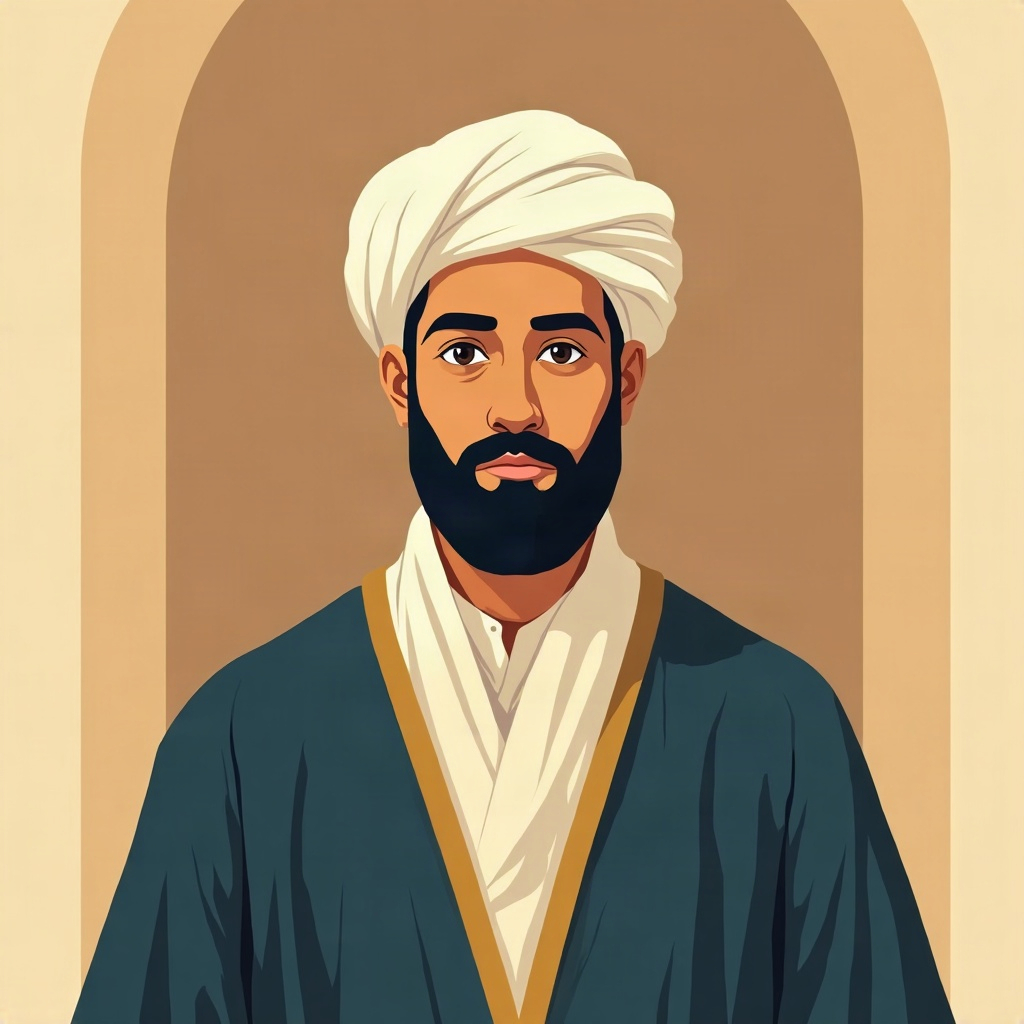
Ibn al-Haytham · 이븐 알하이삼 — Cairo, c. 1030
💡 The Idea
Ibn al-Haytham (about 965 - about 1040), known in Europe as Alhazen, was born in Basra, studied in Basra and Baghdad, and died in Cairo. He wrote more than 200 works, and about 50 survive. His seven-volume Book of Optics (Kitab al-Manazir) is in a list of the works that he wrote between about 1028 and 1038, so the historian A. I. Sabra dates it to those years. Some popular sources say 1011-1021, but that date comes from a later story about his life. It argues that we see because light from an object enters the eye, not because the eye sends out rays, which is the older theory of Euclid and Ptolemy. His book also shows how to test ideas with experiments, so that others can repeat them. One famous test uses a dark room. In Book I of the Book of Optics, he puts several lamps outside a dark room with a small opening. On the wall inside there is one patch of light for each lamp, on a straight line through the opening. If one lamp is covered, only its light goes away. This shows that light travels in straight lines, and that the lights from different things do not mix in the air. In a later work, On the Form of the Eclipse, he studied the upside-down crescent of light that the sun makes through a small round hole during an eclipse. These tests are early steps toward the camera obscura. They do not show how the eye itself works. Ibn al-Haytham did not treat the eye as a dark chamber; Johannes Kepler made that comparison in the early 1600s. The ray diagrams that students draw in modern optics classes look very similar. About the sources: the places and dates of his life, the Book of Optics, the rejection of the "rays from the eye" theory, come from reviews in the medical journals Annals of Saudi Medicine (2007), Saudi Journal of Ophthalmology (2021) and Oman Journal of Ophthalmology (2012), and from a 2010 Royal Society paper. The date of the Book of Optics, the lamp test and the eclipse study come from A. I. Sabra's 1989 English translation of Books I-III of the Book of Optics and its introduction. The note that Kepler explained vision with the dark-chamber model comes from the Stanford Encyclopedia of Philosophy entry on Kepler. Dates differ slightly between sources (death 1039 or 1040). Sabra says he died in or soon after 1040-41, and that the birth year 965 rests on one later note, so we write "about". Many details of his life are lost, and the stories about him are often contradictory. A later writer, Ibn al-Qifti (13th century), told a famous anecdote that Ibn al-Haytham pretended to be mad to escape the angry ruler of Egypt. Historians cannot confirm it, so this unit does not use it. The conversation with the student is invented, and the student is not a real person.
이븐 알하이삼(965년경~1040년경)은 유럽에서 알하젠이라고 불렸어요. 그는 바스라에서 태어나 바스라와 바그다드에서 공부했고, 카이로에서 세상을 떠났어요. 그는 200편이 넘는 작품을 썼고, 그중 약 50편이 남아 있어요. 일곱 권으로 된 《광학의 서》(키타브 알마나지르)는 그가 1028년에서 1038년 무렵 사이에 쓴 작품 목록에 들어 있어서, 역사학자 A. I. 사브라는 이 책을 그 시기의 것으로 봐요. 몇몇 대중적인 자료는 1011~1021년이라고 하지만, 그 연도는 그의 삶에 대한 나중의 이야기에서 나온 거예요. 이 책은 눈이 광선을 내보내기 때문이 아니라 물체에서 온 빛이 눈으로 들어오기 때문에 우리가 본다고 주장해요. 눈에서 광선이 나간다는 것은 유클리드와 프톨레마이오스의 옛 이론이에요. 이 책은 다른 사람도 되풀이할 수 있도록 실험으로 생각을 시험하는 방법도 보여 줘요. 유명한 시험 중 하나는 어두운 방을 써요. 《광학의 서》 1권에서 그는 작은 틈이 있는 어두운 방 밖에 등불 여러 개를 놓아요. 방 안의 벽에는 등불 하나마다 빛 조각이 하나씩, 틈을 지나는 곧은 선 위에 생겨요. 등불 하나를 가리면 그 등불의 빛만 사라져요. 이 시험은 빛이 곧은 선으로 나아가고, 서로 다른 물체에서 온 빛이 공기 중에서 섞이지 않는다는 것을 보여 줘요. 나중에 쓴 《일식의 모양에 대하여》에서 그는 일식 때 해가 작은 둥근 구멍을 지나 만드는 거꾸로 된 초승달 모양의 빛을 연구했어요. 이런 시험은 카메라 옵스큐라로 가는 이른 걸음이에요. 하지만 눈 자체가 어떻게 작동하는지는 보여 주지 않아요. 이븐 알하이삼은 눈을 어두운 방처럼 보지 않았어요. 그런 비교는 1600년대 초에 요하네스 케플러가 했어요. 오늘날 학생들이 광학 수업에서 그리는 광선 그림도 이것과 아주 비슷해요. 출처에 대해: 그의 생애의 장소와 연도, 《광학의 서》, "눈에서 광선이 나간다"는 이론을 부정한 것은 의학 저널 《사우디 의학 연보》(2007), 《사우디 안과학 저널》(2021), 《오만 안과학 저널》(2012), 그리고 2010년 왕립학회 논문에서 가져왔어요. 《광학의 서》의 연도, 등불 시험, 일식 연구는 A. I. 사브라가 1989년에 영어로 옮긴 《광학의 서》 1~3권과 그 해설에서 가져왔어요. 케플러가 어두운 방 모형으로 보는 일을 설명했다는 내용은 《스탠퍼드 철학 백과사전》의 케플러 항목에서 가져왔어요. 연도는 자료마다 조금씩 달라요(사망 1039년 또는 1040년). 사브라는 그가 1040~1041년 또는 그 직후에 세상을 떠났고, 965년이라는 출생 연도는 나중의 기록 하나에만 기대고 있다고 말해요. 그래서 "~년경"이라고 썼어요. 그의 삶은 많은 부분이 잊혔고, 그에 관한 이야기는 서로 어긋나는 경우가 많아요. 13세기의 작가 이븐 알키프티는 이븐 알하이삼이 이집트 통치자의 분노를 피하려고 미친 척했다는 유명한 일화를 전해요. 역사가들은 이 이야기를 확인할 수 없어서 이 단원에서는 쓰지 않았어요. 학생과의 대화는 지어낸 것이고, 학생은 실제 인물이 아니에요.
📚 Grammar focus
Relative clauses (who / which / that)
✏️ Try it
Join the two sentences with who, which or that. 1. Ibn al-Haytham is a scholar. He studied light. 2. This is a room. It has no windows. 3. The light comes through the hole. It travels in straight lines. 4. The students asked questions. They stood in the dark room. 5. The lights appear on the wall. The wall is opposite the hole. Bonus: Write two sentences about your own life. Use "who" in one and "that" or "which" in the other.
전체 레슨을 보고 싶으세요?
Want the full lesson?
회화 연습, 역할극, 문법, 그리고 진짜 선생님이 안에 있어요.
Conversation practice, roleplay, grammar, and a real tutor are inside.