Eureka! · No. 68
Four Little Stars Beside Jupiter
목성 곁의 작은 별 네 개
Galileo Galilei · 갈릴레오 갈릴레이 — Padua, Italy, 1610
💡 The Idea
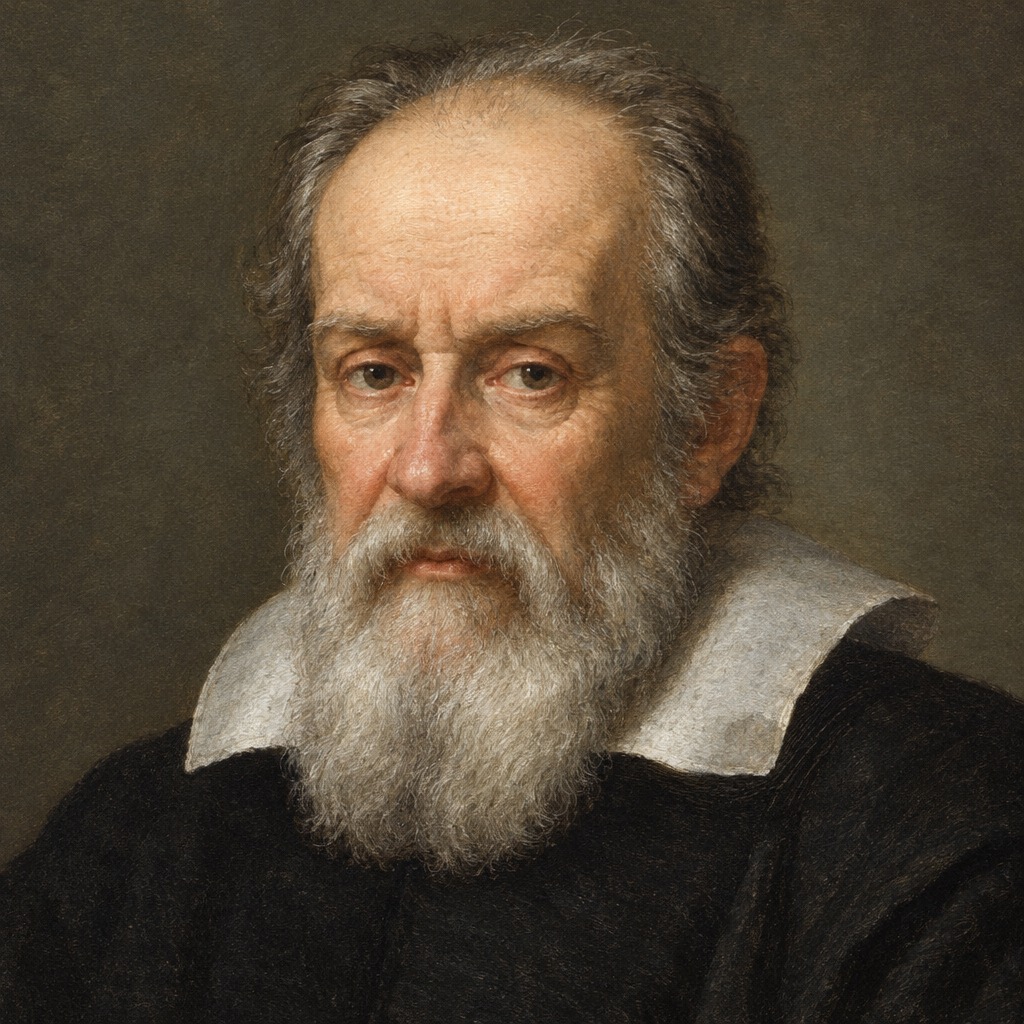
Galileo Galilei was born in Pisa on 15 February 1564 and died in 1642. According to the Stanford Encyclopedia of Philosophy (SEP), he got a chair of mathematics at the University of Padua in 1592. In 1609 he heard about the recently invented spyglass, made an improved telescope and used it to make "astounding" discoveries in the sky. In his book Sidereus Nuncius ("Starry Messenger" or "Sidereal Messenger") Galileo tells the story himself. About ten months before he wrote, a report reached him that a Dutchman had made a telescope, and a letter from Jacques Badovere in Paris confirmed it. He decided to find out how it worked. He first used a tube with two glass lenses. After that he made better ones, and he wrote that his best made objects look "more than thirty times nearer". He turned it first to the Moon and then to other bodies in the sky. The key nights are in the book. On 7 January 1610, "in the first hour of the following night", he saw three small, bright stars near Jupiter in a straight line. He believed they were fixed stars. On 8 January they were all on the west side. He was surprised, and he was afraid that Jupiter might have moved differently from the astronomers' tables. On 9 January the sky was cloudy. On 10 January only two stars were visible, both east of Jupiter. He then understood that the change belonged "not to Jupiter, but to the stars". On 11 January he concluded that there were three stars moving about Jupiter, as Venus and Mercury move round the Sun. On 13 January, for the first time, he saw four. What did it mean? Galileo wrote that the four bodies keep close to Jupiter, go in front of and behind it, and travel with it. So they circle Jupiter. He also argued that this removes a worry of people who accept the planets going around the Sun but cannot accept one Moon going around the Earth. Now Jupiter had four of them. Our short summary, "not everything circles the Earth", follows from this. The book does not prove that the Earth moves. Galileo named the four bodies the Medicean stars. The licence to print is dated 1 March 1610, his dedication to Cosimo II de' Medici is dated Padua, 12 March 1610, and SEP says the book appeared in March 1610. SEP also says that Kepler praised it and that astronomers at the Collegio Romano confirmed its results. About the sources: the observations, the dates, the Dutch report and the letter from Paris come from the English text of the Sidereus Nuncius (translation by Edward Stafford Carlos, 1880, edited by Peter Barker, 2004) on the Internet Archive. We could not use the Van Helden translation. Dates are as printed in the book. Because the talk takes place in January 1610, before the book was written, Galileo says "last year" in the story instead of the book's "about ten months ago". Galileo's life dates and the 1609 spyglass story come from SEP. The dialogue with the assistant is imagined, and the assistant is not a real person. We did not use two popular stories, the Leaning Tower of Pisa drop and the phrase "Eppur si muove", because we could not find firm sources for them here.
갈릴레오 갈릴레이는 1564년 2월 15일 피사에서 태어나 1642년에 세상을 떠났어요. 스탠퍼드 철학 백과사전(SEP)에 따르면 그는 1592년에 파도바 대학교의 수학 교수 자리를 얻었어요. 1609년에 그는 새로 발명된 스파이글래스(작은 망원경)에 대해 듣고 더 좋은 망원경을 만들어 하늘에서 '놀라운' 발견을 했어요. 그의 책 《시데레우스 눈치우스》('별의 전령')에서 갈릴레오가 직접 이야기를 들려줘요. 책을 쓰기 열 달쯤 전에 어떤 네덜란드 사람이 망원경을 만들었다는 소문이 그에게 닿았고, 파리의 자크 바도베르가 보낸 편지가 그것을 확인해 줬어요. 그는 그것이 어떻게 작동하는지 알아내기로 했어요. 처음에는 유리 렌즈 두 개를 단 통을 썼어요. 그 뒤 더 좋은 것을 만들었고, 가장 좋은 것은 물체를 '서른 배가 넘게 가깝게' 보이게 한다고 썼어요. 그는 먼저 달에, 그다음 하늘의 다른 천체들에 망원경을 향했어요. 중요한 밤들은 책에 나와요. 1610년 1월 7일 '다음 밤 첫 시간'에 그는 목성 근처에서 작고 밝은 별 세 개가 한 줄로 서 있는 것을 봤어요. 그는 붙박이별이라고 믿었어요. 1월 8일에는 모두 서쪽에 있었어요. 그는 놀랐고, 목성이 천문학자들의 표와 다르게 움직인 건 아닌지 걱정했어요. 1월 9일은 흐렸어요. 1월 10일에는 별 두 개만 보였고 둘 다 목성 동쪽에 있었어요. 그때 그는 위치의 변화가 '목성이 아니라 그 별들'에게 속한다는 것을 깨달았어요. 1월 11일에 그는 별 세 개가 금성과 수성이 태양을 돌듯 목성을 돈다고 결론 내렸어요. 1월 13일에는 처음으로 네 개를 봤어요. 이것은 무슨 뜻일까요? 갈릴레오는 이 네 천체가 목성 가까이에 머물고, 목성의 앞뒤로 오가며, 목성과 함께 움직인다고 썼어요. 그러니 이들은 목성을 도는 거예요. 그는 또 이것이, 행성이 태양을 도는 것은 받아들이지만 달 하나가 지구를 도는 것은 받아들이지 못하는 사람들의 걱정을 없애 준다고 주장했어요. 이제 목성에게는 달이 네 개나 있으니까요. '모든 것이 지구를 도는 것은 아니다'라는 우리의 짧은 요약은 여기서 나와요. 이 책이 지구가 움직인다는 것을 증명하는 것은 아니에요. 갈릴레오는 이 네 천체를 '메디치의 별'이라고 불렀어요. 인쇄 허가는 1610년 3월 1일자이고, 코시모 2세 데 메디치에게 바치는 헌정문에는 파도바, 1610년 3월 12일이라고 적혀 있어요. SEP는 이 책이 1610년 3월에 나왔다고 말해요. SEP는 또 케플러가 칭찬했고 로마 대학의 천문학자들이 결과를 확인해 줬다고 해요. 출처에 대해: 관측, 날짜, 네덜란드 소문, 파리에서 온 편지는 인터넷 아카이브에 있는 《시데레우스 눈치우스》 영어 본문에서 가져왔어요(에드워드 스태퍼드 카를로스가 1880년에 옮기고 피터 바커가 2004년에 다듬은 판이에요). 판 헬던의 번역은 쓰지 못했어요. 날짜는 책에 인쇄된 대로예요. 대화는 책을 쓰기 전인 1610년 1월에 일어나므로, 이야기 속 갈릴레오는 책의 '열 달쯤 전' 대신 '작년'이라고 말해요. 갈릴레오의 생몰 연도와 1609년 스파이글래스 이야기는 SEP에서 가져왔어요. 조수와의 대화는 상상한 것이고, 조수는 실제 인물이 아니에요. 피사의 사탑에서 물건을 떨어뜨렸다는 이야기와 'Eppur si muove'라는 말은 여기서 확실한 출처를 찾지 못해 쓰지 않았어요.
📚 Grammar focus
Indirect questions (I wonder if / He asked whether / Can you tell me how...)
✏️ Try it
Change each direct question into an indirect question. 1. "How does the telescope work?" → Can you tell me _______ ? 2. "Does Jupiter move?" → I wonder _______ . 3. "Where are the stars?" → Do you know _______ ? 4. "What did he see?" → Can you tell me _______ ? 5. Correct the mistake: "I wondered how did Jupiter move." 6. "Will people believe him?" → He asked _______ . Bonus: Write two indirect questions that you want to ask your teacher. Start with "Can you tell me..." and "Do you know...".
전체 레슨을 보고 싶으세요?
Want the full lesson?
회화 연습, 역할극, 문법, 그리고 진짜 선생님이 안에 있어요.
Conversation practice, roleplay, grammar, and a real tutor are inside.