Eureka! · No. 50
The Nurse Who Drew the Truth
진실을 그림으로 그린 간호사
Florence Nightingale · 플로렌스 나이팅게일 — Scutari, 1854-1855
💡 The Idea
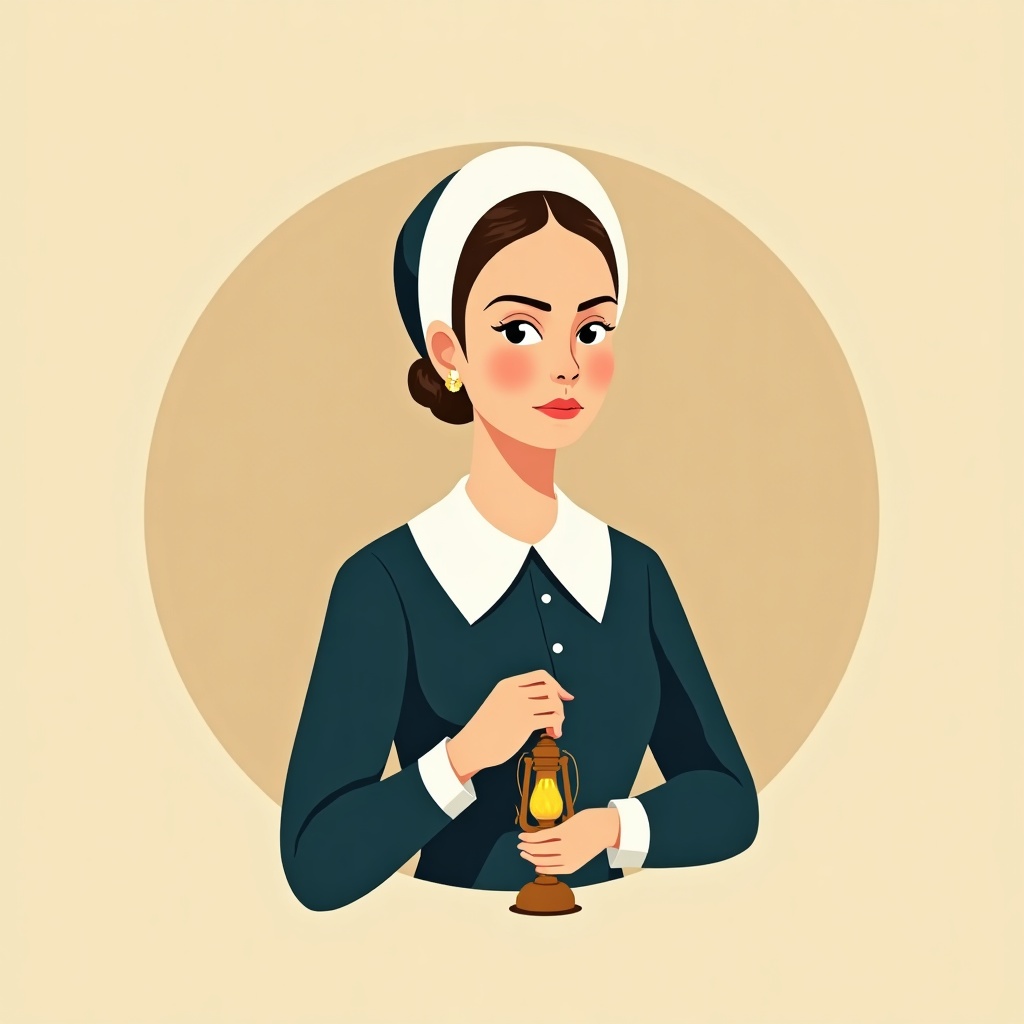
Florence Nightingale was born on 12 May 1820 in Florence, Italy, and died on 13 August 1910. Her wealthy family did not want her to be a nurse. She trained for a short time in Germany, and later she ran a small nursing home in London. In 1854 the British government asked her to lead a group of nurses for the military hospitals in Turkey. She arrived at Scutari Barracks Hospital in November 1854 with 38 nurses. The museum in her name says that she worked to improve food, blankets, beds and cleanliness. The hospital's biggest problems were in its buildings. A Sanitary Commission was sent to Scutari in 1855, and it began work in March 1855. Dr John Sutherland co-led it, and Nightingale supported it. The Commission found that the hospital stood on a blocked sewer and that there were dead animals on the site. It cleared the sewer and the water tanks, cleaned the hospital and washed the walls with lime. The Commission's report says that the repairs helped to lower the death rate. The "Lady with the Lamp" image has a clear source. Early in 1855, The Times printed a letter from Scutari by John Macdonald, the man who gave out money from a fund that The Times had collected for the soldiers. He wrote that at night "she may be observed alone, with a little lamp in her hand, making her solitary rounds." On 24 February 1855 the Illustrated London News printed the same words with a picture. In 1857 the American poet Longfellow wrote about "a Lady with a Lamp" in his poem "Santa Filomena". The lamp is a true detail of her night rounds, but it also became part of a legend. Here is an honest note about numbers. A popular story says that Nightingale cut the death rate from more than 40 percent to about 2 percent. Historians disagree about how much, and how fast, and about who did what. The historian Lynn McDonald, who has studied Nightingale's own papers, says the fall in deaths was real, but it came after the Sanitary Commission started its work in March 1855. She also says that Nightingale never claimed that nurses alone had lowered the death rate, and that the official figures often combine several hospitals. Nightingale's own figure for February 1855 is "nearly 43 percent" of the cases treated at the Scutari and Koulali hospitals. Her great skill was to show the link between dirt and disease, and she did that mostly after the war. After the war, Nightingale studied official War Office records with the help of experts such as the statistician William Farr. She found that more men died of disease than of wounds. She used charts to show this. One famous chart is a polar area diagram, a circle with wedges. In her 1858 report, each wedge is one month. One circle shows the first year of the war (April 1854 to March 1855), and the other circle shows the second year (April 1855 to March 1856), so readers can compare the time before and after the repairs began in March 1855. Her museum says that her charts showed that more men had died of disease than of wounds, and that the Royal Commission on the health of the army led to many improvements. Statisticians in Europe already used polar area diagrams, but Nightingale used one to make government leaders understand. In 1860 the Nightingale Training School opened at St Thomas' Hospital, and she became the first woman elected to the Royal Statistical Society. About the sources: the Florence Nightingale Museum, a 2020 article in The Lancet by a Science Museum curator, a 2020 article by Noel-Ann Bradshaw, and McDonald's 2016 paper (all listed in the ledger). The lamp words come from Sir Edward Cook's 1913 biography of Nightingale and from the Illustrated London News of 24 February 1855. The details of the diagram come from her 1858 report on the deaths in the British Army. The conversation is imagined.
플로렌스 나이팅게일은 1820년 5월 12일 이탈리아 피렌체에서 태어났고 1910년 8월 13일에 세상을 떠났어요. 부유한 가족은 그녀가 간호사가 되는 것을 원하지 않았어요. 그녀는 독일에서 잠시 훈련을 받았고, 나중에 런던의 작은 요양원을 운영했어요. 1854년 영국 정부는 그녀에게 튀르키예의 군 병원에서 일할 간호사 팀을 이끌어 달라고 부탁했어요. 그녀는 1854년 11월 간호사 38명과 함께 스쿠타리 병영 병원에 도착했어요. 그녀의 이름을 딴 박물관은 그녀가 음식, 담요, 침대, 청결을 개선하려고 애썼다고 말해요. 병원의 가장 큰 문제는 건물에 있었어요. 위생위원회가 1855년 스쿠타리에 파견되었고, 1855년 3월에 일을 시작했어요. 존 서덜랜드 박사가 위원회를 함께 이끌었고, 나이팅게일은 이를 도왔어요. 위원회는 병원이 막힌 하수도 위에 서 있고 부지에 죽은 동물이 있다는 것을 알아냈어요. 하수도와 물탱크를 뚫고 병원을 청소하고 벽을 석회로 씻었어요. 위원회의 보고서는 이 수리가 사망률을 낮추는 데 도움이 되었다고 말해요. '등불을 든 여인'의 이미지는 출처가 분명해요. 1855년 초 《타임스》는 스쿠타리에서 온 존 맥도널드의 편지를 실었어요. 맥도널드는 《타임스》가 병사들을 위해 모은 기금의 돈을 나눠 주던 사람이에요. 그는 밤에 "그녀가 작은 등불을 손에 들고 홀로 순회하는 모습을 볼 수 있다"고 썼어요. 1855년 2월 24일 《일러스트레이티드 런던 뉴스》는 같은 글을 그림과 함께 실었어요. 1857년 미국 시인 롱펠로는 시 〈산타 필로메나〉에서 '등불을 든 여인'에 대해 썼어요. 등불은 그녀의 밤 순회에 대한 사실적인 모습이지만, 전설의 일부이기도 해요. 숫자에 대한 솔직한 설명이에요. 널리 알려진 이야기는 나이팅게일이 사망률을 40퍼센트가 넘던 데서 약 2퍼센트로 줄였다고 해요. 역사학자들은 얼마나, 얼마나 빨리, 그리고 누가 무엇을 했는지에 대해 의견이 갈려요. 나이팅게일 본인의 글을 연구한 역사학자 린 맥도널드는 사망이 줄어든 것은 사실이지만 그것은 위생위원회가 1855년 3월에 일을 시작한 뒤라고 말해요. 또 나이팅게일은 간호사만으로 사망률이 줄었다고 주장한 적이 없고, 공식 수치는 여러 병원을 합친 경우가 많다고 해요. 1855년 2월에 대한 나이팅게일 본인의 수치는 스쿠타리와 쿨랄리 병원에서 치료받은 환자의 "거의 43퍼센트"예요. 그녀의 큰 재능은 더러움과 질병 사이의 연결을 보여 준 것이고, 그 일은 대부분 전쟁이 끝난 뒤에 했어요. 전쟁이 끝난 뒤 나이팅게일은 통계학자 윌리엄 파 같은 전문가의 도움을 받아 육군성의 공식 기록을 연구했어요. 그녀는 상처보다 질병으로 죽은 사람이 더 많다는 것을 알아냈어요. 이를 보여 주려고 그림을 썼어요. 유명한 그림 하나는 부채꼴이 있는 원, 극좌표 면적 도표예요. 1858년 보고서에서 부채꼴 하나는 한 달이에요. 한 원은 전쟁의 첫해(1854년 4월~1855년 3월)를, 다른 원은 둘째 해(1855년 4월~1856년 3월)를 보여 줘서, 1855년 3월에 수리가 시작되기 전과 후를 비교할 수 있어요. 박물관은 그녀의 도표가 상처보다 질병으로 죽은 병사가 더 많다는 것을 보여 주었고, 군 보건에 대한 왕립위원회가 많은 개선으로 이어졌다고 말해요. 유럽의 통계학자들도 이미 극좌표 면적 도표를 썼지만, 나이팅게일은 정부 지도자들을 이해시키려고 이 도표를 썼어요. 1860년 세인트토머스 병원에 나이팅게일 간호학교가 문을 열었고, 그녀는 왕립통계학회의 첫 여성 회원이 되었어요. 출처에 대해: 플로렌스 나이팅게일 박물관, 과학박물관 큐레이터가 쓴 2020년 《랜싯》 글, 노엘앤 브래드쇼의 2020년 글, 맥도널드의 2016년 논문이에요(모두 장부에 있어요). 등불에 대한 글은 에드워드 쿡 경이 1913년에 쓴 나이팅게일 전기와 1855년 2월 24일 《일러스트레이티드 런던 뉴스》에서 가져왔어요. 도표의 자세한 내용은 영국 군대의 사망에 대한 그녀의 1858년 보고서에서 가져왔어요. 대화는 상상한 것이에요.
📚 Grammar focus
Quantifiers and comparing amounts (more / fewer / most / too few)
✏️ Try it
Choose the best word for each sentence. 1. There were too _______ beds for all the sick men. (few / little) 2. _______ of the men were sick, not wounded. (Most / Much) 3. After the repairs, _______ men died. (fewer / less) 4. We do not have _______ clean water. (many / enough) 5. The bigger the wedge, the _______ deaths. (more / most) Bonus: Write two sentences that compare two things in your class. Use "more ... than" and "fewer ... than".
전체 레슨을 보고 싶으세요?
Want the full lesson?
회화 연습, 역할극, 문법, 그리고 진짜 선생님이 안에 있어요.
Conversation practice, roleplay, grammar, and a real tutor are inside.