Eureka! · No. 79
The Needle That Jumped
튀어 오른 나침반 바늘
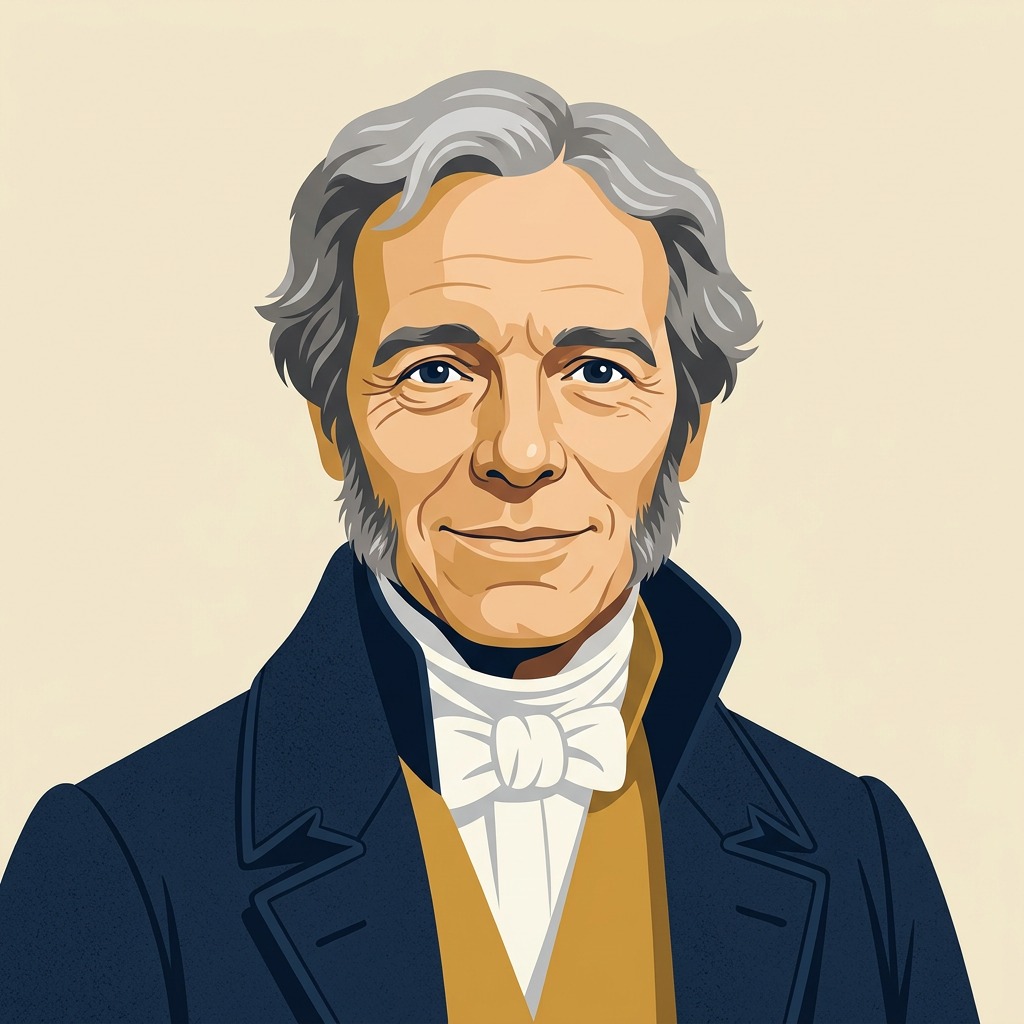
Michael Faraday · 마이클 패러데이 — London, England, 29 August 1831
💡 The Idea
Michael Faraday was born on 22 September 1791 at Newington, then in Surrey, near London. His father James was a blacksmith. Bence Jones's Life and Letters of Faraday says that in the hard year 1801 the family got public relief, and Michael, nine years old, got one loaf a week. Faraday himself wrote that his education "was of the most ordinary description": reading, writing and arithmetic at a common day-school. The tale that he was "only a poor boy" needs care. He was poor and had little schooling, and the source above says so. But he did not do it alone. In 1804 he began as an errand boy for the bookseller George Riebau. His apprenticeship papers are dated 7 October 1805, and they say that no premium (fee) was paid. Faraday wrote that, while an apprentice, he "loved to read the scientific books which were under my hands", for example Marcet's Conversations on Chemistry and the articles on electricity in the Encyclopaedia Britannica. His master let him go to evening lectures by John Tatum in 1810-1811, and his older brother Robert gave him the shilling for several of them. A customer of the shop, Mr. Dance, took him to four of Humphry Davy's last lectures at the Royal Institution in 1812 (29 February, 14 March, 8 and 10 April). Faraday wrote up the notes, sent them to Davy, and Davy answered on 24 December 1812. In March 1813 the managers of the Royal Institution took on Faraday, 21 years old, as an assistant. So the better version is: a poor boy with little schooling, a lot of curiosity and hard work, and several people who gave him chances. The discovery: Bence Jones writes that "On August 29, 1831, Faraday began his 'Electrical Researches.'" The first experiment, as quoted from the laboratory notebook, used a soft iron ring six inches across, with copper wire wound on two sides: three lengths of about 24 feet on side A, and about 60 feet in two pieces on side B. The ends of the B coil went to a wire that passed over a magnetic needle three feet away. When the A coil was connected to a battery of ten pairs of plates, the notebook says there was "immediately a sensible effect on needle. It oscillated and settled at last in original position. On breaking connection of A side with battery, again a disturbance of the needle." So the effect was short: a push when the current started or stopped, not a steady current. This was not his first try. Bence Jones records that in December 1824, in November 1825, on 2 December 1825 and on 22 April 1828, Faraday had tried similar tests without success. For the tests of 1825 and 1828, the book uses the words "no result". Then, in about ten days of experiments (29 August to 4 November 1831), he found induced currents with the ring, with bar magnets, with a magnet pushed into a coil, and with a copper disc turned between magnet poles. The first series of Experimental Researches in Electricity was read at the Royal Society on 24 November 1831. What we could not check: we did not read the Diary itself (it is printed in seven volumes, but the online copies are closed to us). The notebook words above come from Bence Jones's book, and the idea that the 1831 copper disc was "the first electric generator" is from Wikipedia only. The two lines of talk with the assistant and Faraday are imagined. The "weed instead of a fish" sentence is a real line from a letter to R. Phillips (23 September 1831), as Bence Jones prints it.
마이클 패러데이는 1791년 9월 22일 런던 근처 서리 지방의 뉴잉턴에서 태어났어요. 아버지 제임스는 대장장이였어요. 벤스 존스의 《패러데이의 삶과 편지》에 따르면, 어려웠던 1801년에 가족은 공적 구호를 받았고 아홉 살 마이클은 매주 빵 한 덩이를 받았어요. 패러데이 자신은 자기 교육이 "아주 평범했다"고 썼어요. 일반 주간 학교에서 읽기, 쓰기, 셈하기를 배운 것이 전부였어요. "그는 가난한 소년일 뿐이었다"는 이야기는 조심해서 봐야 해요. 그는 가난했고 학교 교육도 적게 받았어요. 위의 자료도 그렇게 말해요. 하지만 혼자 해낸 것은 아니에요. 1804년에 그는 서점 주인 조지 리보의 심부름꾼으로 일을 시작했어요. 견습 계약서는 1805년 10월 7일 자이고, 수업료(premium)를 내지 않았다고 적혀 있어요. 패러데이는 견습생일 때 "내 손에 들어온 과학책을 읽는 것을 좋아했다"고 썼고, 예로 마르셋의 《화학 대담》과 《브리태니커 백과사전》의 전기 항목들을 들었어요. 주인은 1810~1811년에 존 태텀의 저녁 강연에 가도록 허락해 주었고, 형 로버트는 그중 여러 번의 1실링을 대 주었어요. 가게의 단골손님 댄스 씨는 1812년에 그를 왕립연구소로 데려가 험프리 데이비의 마지막 강연 네 번(2월 29일, 3월 14일, 4월 8일과 10일)을 듣게 해 주었어요. 패러데이는 필기를 정리해 데이비에게 보냈고, 데이비는 1812년 12월 24일에 답장했어요. 1813년 3월 왕립연구소 운영진은 21세의 패러데이를 조수로 받아들였어요. 그러니 더 정확한 이야기는 이래요. 가난하고 학교 교육을 적게 받았지만 호기심과 노력이 많았고, 기회를 준 사람들이 여럿 있었던 소년이에요. 발견은 이래요. 벤스 존스는 "1831년 8월 29일, 패러데이는 '전기 연구'를 시작했다"고 써요. 실험 노트에서 인용한 첫 실험은 지름 6인치의 연철(무른 철) 고리를 썼고, 양쪽에 구리선을 감았어요. A쪽에는 약 24피트짜리 세 가닥을, B쪽에는 합쳐서 약 60피트인 두 조각을 감았어요. B 코일의 양 끝은 3피트 떨어진 자침 위를 지나는 전선에 이어졌어요. A 코일을 전지 10쌍과 연결하자 노트에는 "곧바로 바늘에 감지할 만한 효과"가 있었고 "바늘이 흔들리다가 마침내 원래 자리에 멈췄다. A쪽의 전지 연결을 끊자 바늘이 다시 흔들렸다"고 적혀 있어요. 그러니 효과는 짧았어요. 전류가 시작되거나 멈출 때 한 번 미는 힘이었고, 꾸준한 전류가 아니었어요. 이것이 첫 시도는 아니었어요. 벤스 존스는 1824년 12월, 1825년 11월, 1825년 12월 2일, 1828년 4월 22일에 패러데이가 비슷한 시험을 했지만 성공하지 못했다고 적어요. 1825년과 1828년의 시험에 대해서는 "결과 없음"이라는 말을 써요. 그러다 약 열흘간의 실험(1831년 8월 29일~11월 4일) 동안 그는 고리, 막대자석, 코일 속으로 밀어 넣은 자석, 자석 극 사이에서 돌린 구리 원판으로 유도 전류를 찾아냈어요. 《전기에 관한 실험 연구》의 첫 번째 시리즈는 1831년 11월 24일 왕립학회에서 읽혔어요. 확인하지 못한 것은 이래요. 《일기(Diary)》 자체는 읽지 못했어요(일곱 권으로 인쇄되었지만 온라인 사본은 우리가 열 수 없었어요). 위의 노트 문장은 벤스 존스의 책에서 가져왔고, 1831년의 구리 원판이 "최초의 발전기"라는 말은 위키백과에만 나와요. 조수와 패러데이의 대사 몇 줄은 상상이에요. "잡초일지도 몰라"라는 문장은 R. 필립스에게 보낸 편지(1831년 9월 23일)에 실제로 있는 말이고, 벤스 존스가 인쇄한 대로 옮겼어요.
📚 Grammar focus
Modals of deduction (must / might / could / can't + be)
✏️ Try it
Choose must, might or can't. 1. The needle moves when the battery starts. There _______ be an electric effect in the second coil. (almost sure) 2. The wire is three feet away from the needle. The battery wire _______ be touching the needle. (almost sure it is not) 3. The needle moves only for a moment. It _______ be a short push, or it _______ be something else. (possible) 4. Faraday has no result after a long test. The idea _______ be wrong, but he is not sure. (possible) 5. The notebook says the needle moved when he connected the battery. So the battery _______ be part of the cause. (almost sure) Bonus: Look at a closed door at your school. Write one sentence with "must", one with "might" and one with "can't" about who is in the room.
전체 레슨을 보고 싶으세요?
Want the full lesson?
회화 연습, 역할극, 문법, 그리고 진짜 선생님이 안에 있어요.
Conversation practice, roleplay, grammar, and a real tutor are inside.