Eureka! · No. 12
The Man Who Proved Things Instead of Just Believing Them
그냥 믿는 대신 증명한 사람
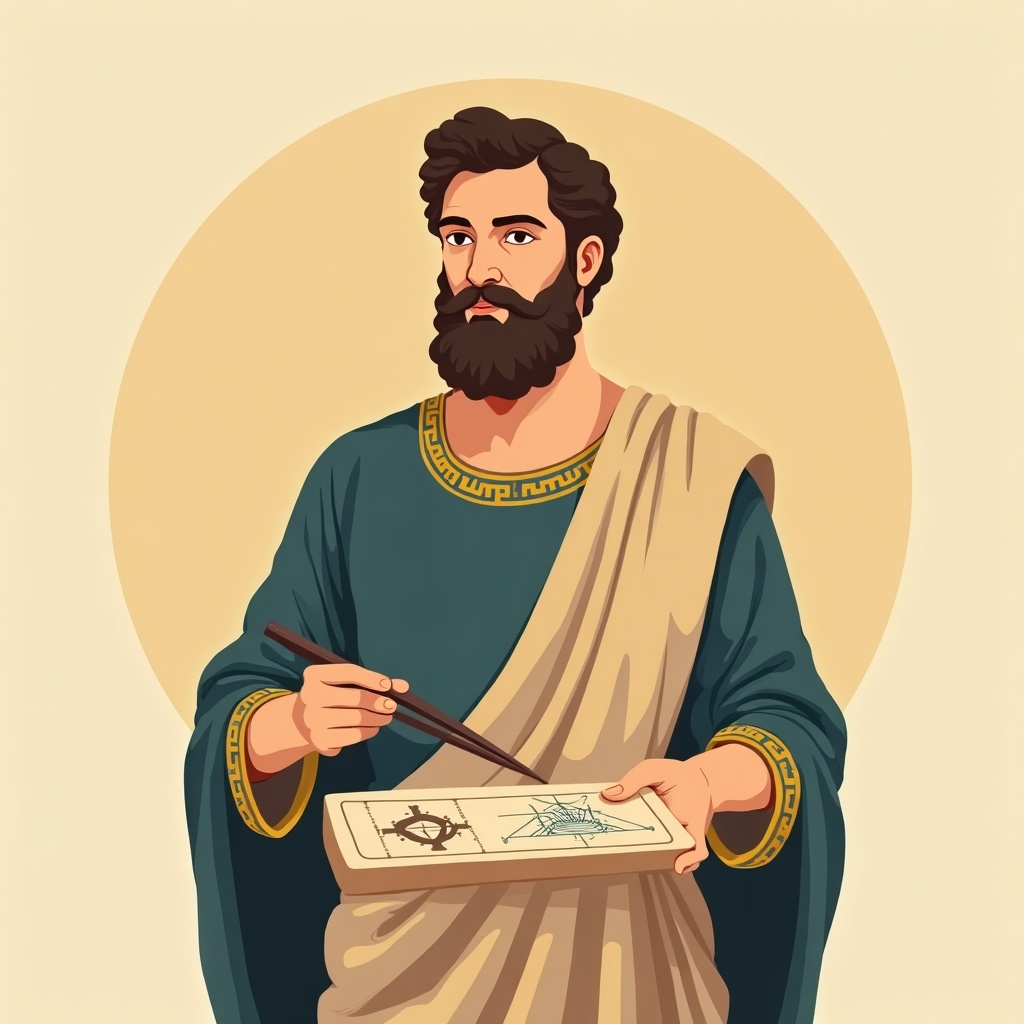
Euclid · 유클리드 — Alexandria, Egypt, c. 300 BCE
💡 The Idea
Euclid's Elements (about 300 BCE) is a very influential mathematics book. Schools used it for over 2,000 years. He built geometry from 5 postulates (starting rules) and 5 common notions. He used a method called deductive proof. Deductive proof works like this. Your starting facts are true. Each logical step is valid. Then your conclusion must be true. It is not probably true. It is necessarily true. Euclid's proof that there are infinitely many primes: 1. Suppose the list of all primes is finite: {2, 3, 5, 7, …, P}. 2. Multiply them all together and add 1: N = (2 × 3 × 5 × … × P) + 1. 3. N must be prime, or some prime must divide it. 4. But dividing N by any prime in the list leaves remainder 1. So no prime in the list divides N. 5. So N is prime, or it has a prime factor outside the list. Either way, the list was not complete. 6. Conclusion: no finite list of primes is complete. There must be infinitely many primes. Many call this one of the most beautiful proofs in mathematics.
유클리드의 《원론》(기원전 약 300년)은 영향력이 매우 큰 수학책이에요. 학교에서 2,000년 넘게 이 책을 썼어요. 그는 5개의 공준(출발 규칙)과 5개의 공통 개념으로 기하학을 세웠어요. 그는 연역적 증명이라는 방법을 썼어요. 연역적 증명은 이렇게 작동해요. 출발하는 사실이 참이에요. 각 논리 단계가 타당해요. 그러면 결론은 반드시 참이어야 해요. 아마 참인 게 아니에요. 필연적으로 참이에요. 소수가 무한히 많다는 유클리드의 증명: 1. 모든 소수의 목록이 유한하다고 가정해요: {2, 3, 5, 7, …, P}. 2. 그것들을 모두 곱하고 1을 더해요: N = (2 × 3 × 5 × … × P) + 1. 3. N은 소수이거나, 어떤 소수가 N을 나누어야 해요. 4. 하지만 N을 목록의 어떤 소수로 나누어도 나머지가 1이에요. 그래서 목록의 어떤 소수도 N을 나누지 못해요. 5. 그러니 N은 소수이거나, 목록 밖의 소인수를 가져요. 어느 쪽이든 목록은 완전하지 않았어요. 6. 결론: 유한한 소수 목록은 완전할 수 없어요. 소수는 무한히 많아야 해요. 많은 사람이 이 증명을 수학에서 가장 아름다운 증명 중 하나라고 불러요.
📚 Grammar focus
Modals of Logic (must / cannot)
✏️ Try it
Apply modal logic (must / cannot) to complete each sentence: 1. 15 is not a prime number, so it _______ have a factor other than 1 and 15. 2. If a number ends in 0, it _______ be an odd number. 3. The number 17 can only be divided by 1 and 17. Therefore 17 _______ be a prime number. Bonus: Verify one step of Euclid's proof. Multiply the first four primes together and add 1: N = (2 × 3 × 5 × 7) + 1 = ? Is N prime? If not, what is its prime factor — and is it in the list {2, 3, 5, 7}?
전체 레슨을 보고 싶으세요?
Want the full lesson?
회화 연습, 역할극, 문법, 그리고 진짜 선생님이 안에 있어요.
Conversation practice, roleplay, grammar, and a real tutor are inside.