Eureka! · No. 12
The Man Who Proved Things Instead of Just Believing Them
그냥 믿는 대신 증명한 사람
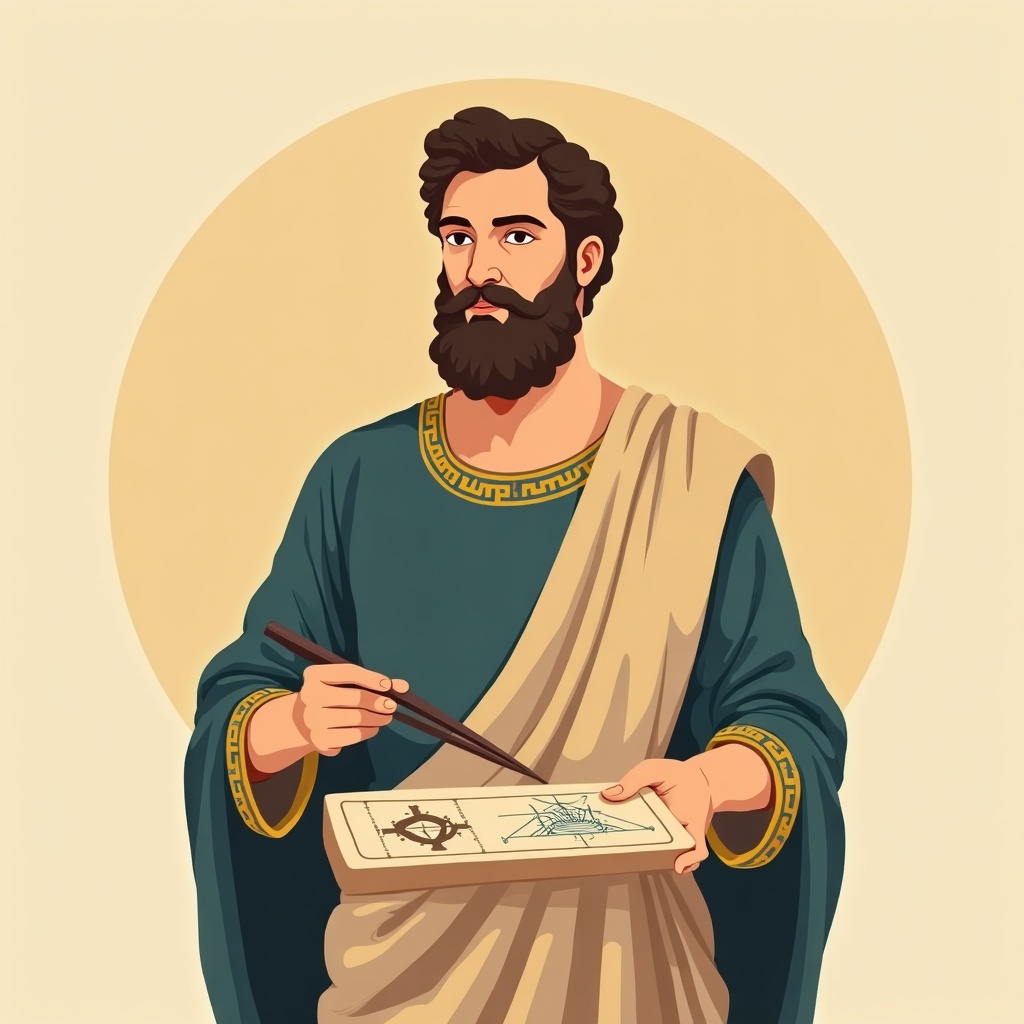
Euclid · 유클리드 — Alexandria, Egypt, c. 300 BCE
💡 The Idea
Euclid's Elements (~300 BCE) is the most influential mathematics textbook ever written. It was used in schools for over 2,000 years — until the 20th century. In it, Euclid built all of geometry from just 5 postulates (starting assumptions) and 5 common notions using a method called deductive proof. Deductive proof means: if your starting facts are true, and each logical step is valid, then your conclusion must be true — not probably true, not usually true, but necessarily true. Euclid's proof that there are infinitely many primes: 1. Assume (for the sake of argument) that the list of all primes is finite: {2, 3, 5, 7, …, P} 2. Multiply them all together and add 1: N = (2 × 3 × 5 × … × P) + 1 3. N must be either prime, or divisible by some prime. 4. But N divided by any prime in the list leaves remainder 1 — so no prime in the list divides N evenly. 5. Therefore N must have a prime factor outside the list — or N itself is prime — contradicting the assumption that the list was complete. 6. Conclusion: no finite list of primes can be complete. There must be infinitely many. This proof is still considered one of the most beautiful in all of mathematics.
유클리드의 원론(기원전 약 300년)은 역사상 가장 영향력 있는 수학 교재예요. 20세기까지 2,000년 이상 학교에서 사용되었어요. 그 안에서 유클리드는 연역적 증명이라는 방법을 사용해 단 5개의 공준(출발 가정)과 5개의 공통 개념으로 기하학 전체를 구축했어요. 연역적 증명이란: 출발하는 사실이 참이고 각 논리적 단계가 유효하다면, 결론은 반드시 참이어야 해요 — 아마 참인 게 아니라, 보통 참인 게 아니라, 반드시 참이어야 해요. 소수가 무한히 많다는 유클리드의 증명: 1. (논증을 위해) 모든 소수의 목록이 유한하다고 가정해요: {2, 3, 5, 7, …, P} 2. 그것들을 모두 곱하고 1을 더해요: N = (2 × 3 × 5 × … × P) + 1 3. N은 소수이거나 어떤 소수로 나누어 떨어져야 해요. 4. 하지만 N을 목록의 어떤 소수로 나누어도 나머지가 1이에요 — 그래서 목록의 어떤 소수도 N을 나누어 떨어지게 할 수 없어요. 5. 따라서 N은 목록 밖의 소수 인수를 가져야 하거나 — N 자체가 소수여야 해요 — 목록이 완전하다는 가정에 모순이 생겨요. 6. 결론: 유한한 소수 목록은 완전할 수 없어요. 소수는 무한히 많아야 해요. 이 증명은 수학 역사상 가장 아름다운 증명 중 하나로 여전히 여겨지고 있어요.
📚 Grammar focus
Modals of Logic (must / cannot)
✏️ Try it
Apply modal logic (must / cannot) to complete each sentence: 1. 15 is not a prime number because it _______ be divided evenly by 3 and 5. 2. If a number ends in 0, it _______ be an odd number. 3. The number 17 can only be divided by 1 and 17. Therefore 17 _______ be a prime number. Bonus: Verify one step of Euclid's proof. Multiply the first four primes together and add 1: N = (2 × 3 × 5 × 7) + 1 = ? Is N prime? If not, what is its prime factor — and is it in the list {2, 3, 5, 7}?
전체 레슨을 보고 싶으세요?
Want the full lesson?
회화 연습, 역할극, 문법, 그리고 진짜 선생님이 안에 있어요.
Conversation practice, roleplay, grammar, and a real tutor are inside.