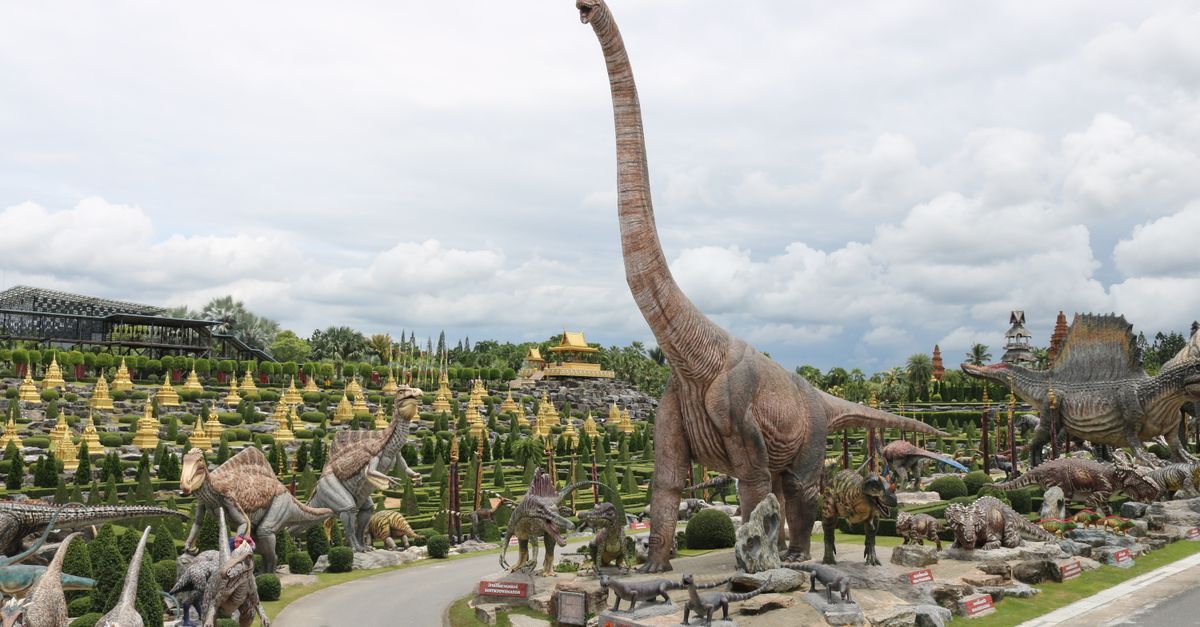
File photo — not from this news story. · See the original story's photos → · Photo: Aman Ullah Khan / Pexels
📰 Daily News
Scientists discover dinosaur as long as a sports field in Thailand
AI가 레벨별로 작성한 세계 뉴스 · World news, written by AI at each level
Imagine an animal as long as a sports field. Scientists in Thailand found exactly that—a brand new dinosaur species buried in the ground.
The dinosaur's name is Uragasaurus kalasinensis. Say it slowly: oo-rah-gah-SAW-rus kah-lah-sin-EN-sis. Scientists named it after the place where they found it and the ancient language of that region. The name tells a story about where the dinosaur lived.
This dinosaur was a plant eater. It ate leaves and plants all day long. A plant-eating dinosaur needs a very long neck and a very long body. Why? Because it has to reach leaves high in the trees and move slowly through forests looking for food. Uragasaurus kalasinensis was built exactly like this.
Here is the exciting part: this dinosaur lived about 150 million years ago. That is a very, very long time. During that time, dinosaurs lived all over Earth. Thailand had warm, wet weather with thick forests. The dinosaur walked through these ancient forests eating plants. Scientists never knew this dinosaur lived in Thailand until now.
How do scientists find a dinosaur? First, they dig carefully in the ground. Then they look at bones and rocks. They study every piece. They compare the bones to other dinosaurs they already know about. This helps them understand if it is a completely new type.
Why is this discovery important? Each new dinosaur teaches us something new. It tells us how dinosaurs lived in different places. It shows us that Earth looked very different long ago. Thailand had different animals then. The weather was different. Everything was different.
Did you know that scientists discover new dinosaurs all the time? Some discoveries are small bones. Some are huge skeletons. Each one is like finding a new page in an ancient history book. Thailand's new dinosaur is one more amazing page.
What do you think it would feel like to see a living dinosaur like Uragasaurus kalasinensis walking through a forest?
Inspired by reporting from BBC News.
📚 Vocabulary
dinosaur
A very large animal that lived millions of years ago and is now extinct.
수백만 년 전에 살았던 매우 큰 동물로, 지금은 멸종했습니다.
plant eater
An animal that eats only plants, leaves, and grass—not meat.
고기가 아닌 식물, 잎, 풀만 먹는 동물입니다.
discover
To find something new that was not known before.
이전에 알려지지 않았던 새로운 것을 찾는 것입니다.
ancient
Very old; from a long time ago.
매우 오래된; 오랜 시간 전부터 있었던.
skeleton
All the bones in a body, connected together.
몸의 모든 뼈가 함께 연결된 것입니다.
Your next step
Step 1 · Free level test
Find your English level in about 12 minutes — free, no signup required.
Take the level test →
Step 2 · Free 30-minute class
Try one real class with Uncle J, free.
Book my free class →
Step 3 · Sign up free to get started ↓
전체 레슨을 보고 싶으세요?
Want the full lesson?
회화 연습, 역할극, 문법, 그리고 진짜 선생님이 안에 있어요.
Conversation practice, roleplay, grammar, and a real tutor are inside.